About Pseudevernia consocians (Vainio) Hale & W.L.Culb.
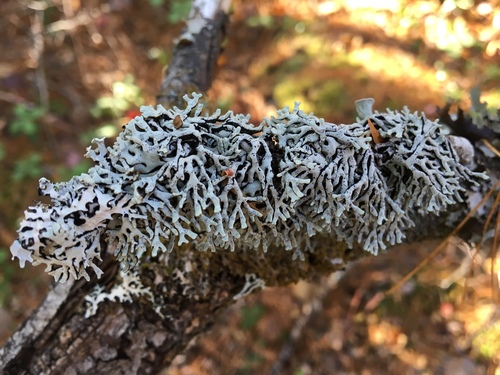
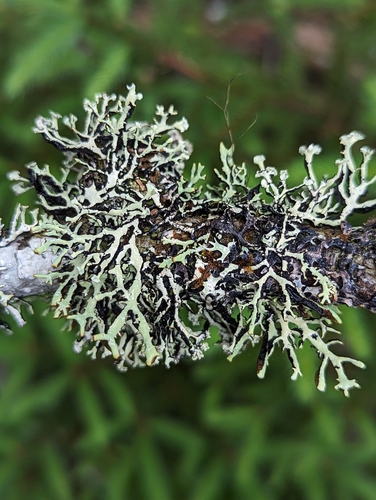
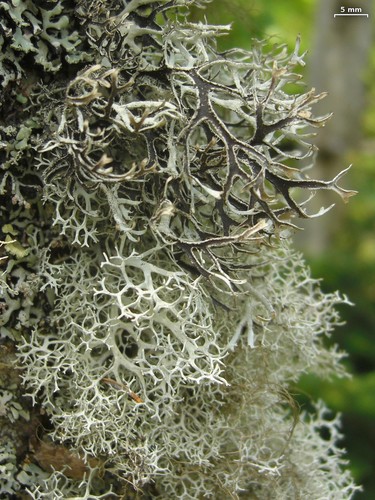
Pseudevernia consocians (Vainio) Hale & W.L.Culb. has a thallus that ranges from leafy (foliose) to somewhat bushy (fruticose) in form. It usually measures 4–10 cm (1.6–3.9 in) in diameter, with a smooth texture and grayish color. The lobes that make up the thallus are linear, dichotomously branched, overlapping, and have truncated tips. They are typically 0.3–1.5 mm wide, with some reaching up to 3 mm wide. Abundant cylindrical isidia grow on the thallus surface, and their tips are darker than the rest of the thallus. The medulla is loosely packed and white. The lower surface of the thallus attaches via basal holdfasts, with no rhizines present. Its lower surface color ranges from tan to black, and sometimes has occasional white mottling. Pycnidia are arranged either laminal or marginal, and can be immersed, emergent, or sessile. Two species that are superficially similar to P. consocians are Pseudevernia cladonia and Evernastrum catawbiense. P. cladonia can be distinguished from P. consocians by its lack of isidia, while E. catawbiense produces soralia instead of isidia. Results of standard chemical spot tests for this species are: upper cortex K+ (yellow), medulla K−, C+ (red), KC+ (red), and P−. The cortex contains atranorin as a major lichen product and chloroatranorin as a minor lichen product. The medulla has lecanoric acid as its major lichen substance. The photobiont partner of Pseudevernia consocians is the green alga Trebouxia jamesii. This species is distributed across the mountains of Mexico, extending south into Central America. It also grows in the Great Lakes and Appalachian region of eastern North America, with disjunct populations reaching into Western Canada. It is common on conifers, and has a particular preference for pine trees. In the Appalachian Mountains, it occurs in dry, acidic environments, specifically at middle-to-high elevations, where it grows between bark plates and on branches.