About Pseudargyrotoza conwagana (Fabricius, 1775)
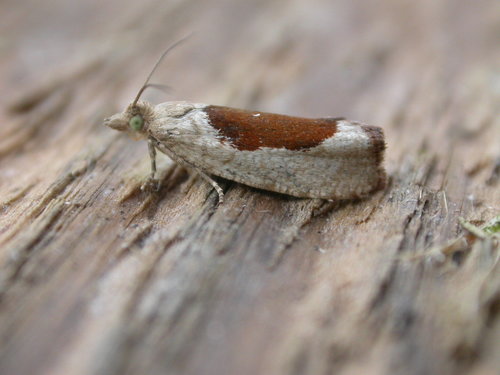
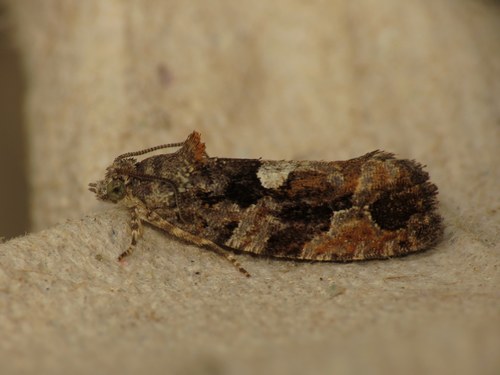
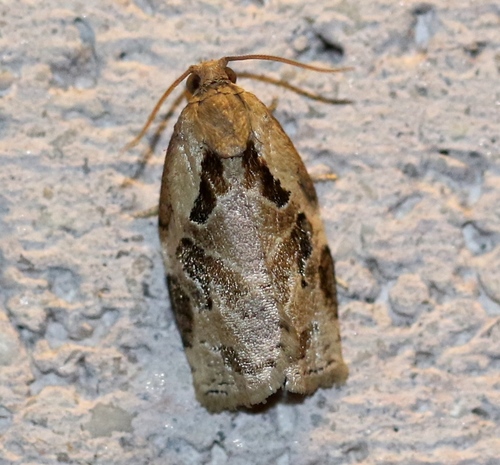
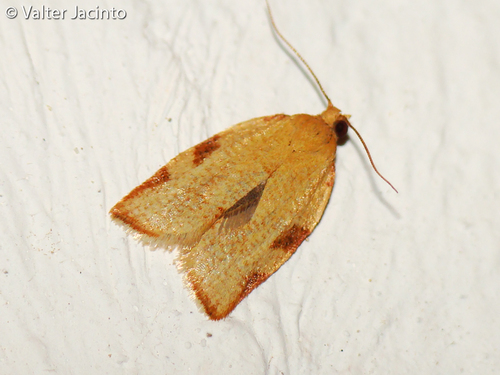
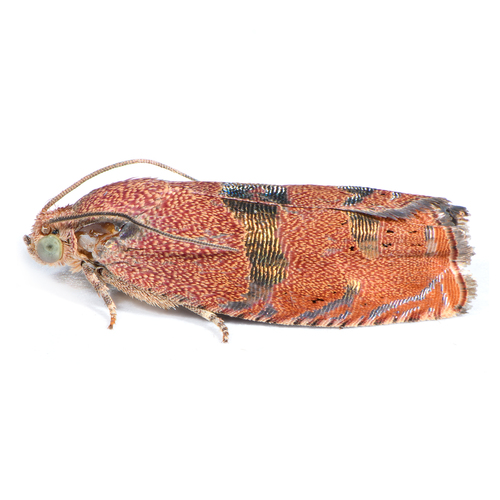
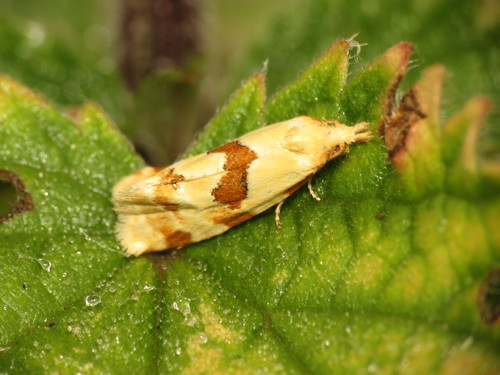
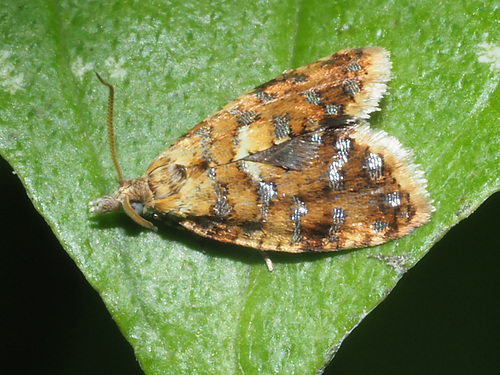
Pseudargyrotoza conwagana (Fabricius, 1775) has a wingspan of 11 to 15 mm, and its thorax is crested. The forewings are triangular and yellow, and are more or less suffused with orange or ferruginous, with faint darker strigulation. A darker basal patch is common, and this patch is always followed by a pale yellow dorsal mark. The central and terminal fasciae are often darker or mixed with blackish, and are edged with leaden-metallic dots. The hindwings are blackish-grey, and are lighter towards the anterior. The larva is yellow-whitish, with a darker dorsal line, and a yellow-brownish head. Adults are active on wing from May to July. Larvae feed on ash (Fraxinus excelsior), Manchurian ash (Fraxinus mandshurica), privet (Ligustrum species, including broad-leaf privet Ligustrum lucidum) and barberry (Berberis species). This species is distributed in Europe, China (Heilongjiang, Jilin, Shaanxi, Sichuan, Beijing, Shandong), South Korea, Japan, Russia (Siberia, Ussuri) and Asia Minor.