About Pseudaphritis urvillii (Valenciennes, 1832)
Appearance
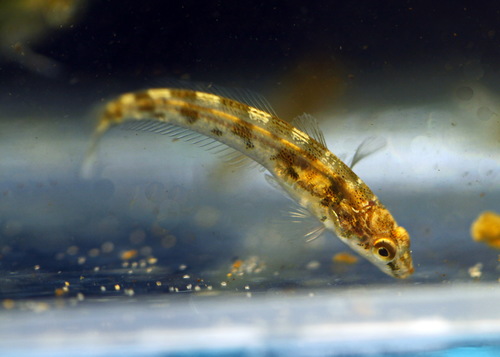
Pseudaphritis urvillii, commonly known as congolli or tupong, is a species of fish endemic to Australia. The congolli is a slender, mottled fish with a silvery-white underside. Its head is slightly flattened, with eyes placed towards the top of the head and a pointed snout. It has two separate dorsal fins.
Colour and Size
Its body colour varies based on its habitat: upper surfaces may be bluish, purplish, or reddish-brown, marbled with greenish-brown, while undersides range from yellowish white to silvery. Juvenile fish have black saddle-shaped markings on their dorsal surfaces. The largest measured adult of this species is approximately 36 centimetres (14 in) long, and most adults typically grow to 17 centimetres (6.7 in) long.
Distribution and Habitat
Congolli can be found in fresh, brackish, and marine waters around south-eastern Australia, including Tasmania. It mostly lives in slow-moving waters of estuaries, rivers, and streams, with habitat water temperatures ranging from 5 to 20 °C (41 to 68 °F). This fish inhabits areas with log snags, overhanging banks, and leaf litter.
Breeding and Records
Between late April and August, it migrates south to estuaries and the sea to breed. In 2017, congolli were recorded for the first time in five rivers on Kangaroo Island in South Australia, through a project led by the Department of Environment, Water and Natural Resources (DEWNR) and carried out by citizen science volunteers. Tupongs (congolli) have recovered in the Glenelg River in south-western Victoria, after being absent from the area for many years.
Congolli are catadromous
Adult Habitat
adults live in freshwater habitats, then migrate downstream to estuaries to spawn. Adult fish migrate south to estuaries to reproduce between late April and August.
Larval Movement
After spawning, larvae are carried out to sea, and slowly move upstream as they grow; larger adult congolli live furthest upstream.


