About Pseudagrion microcephalum (Rambur, 1842)
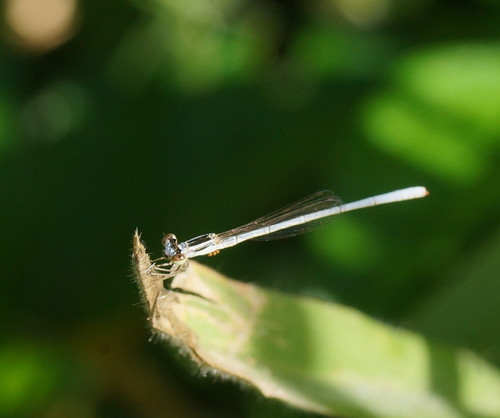
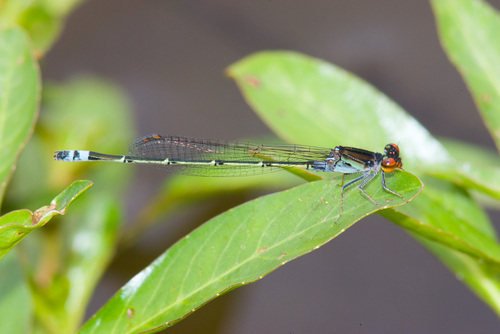
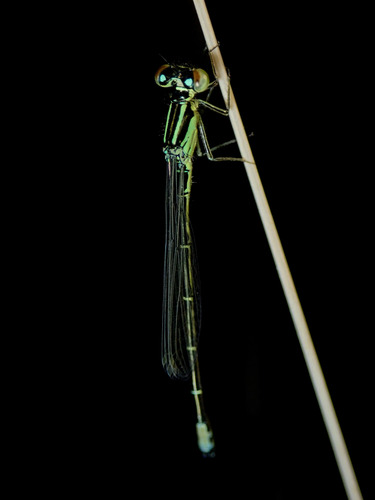
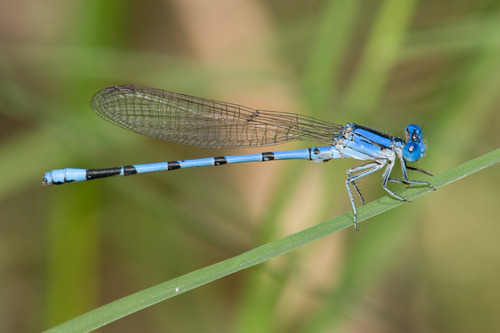
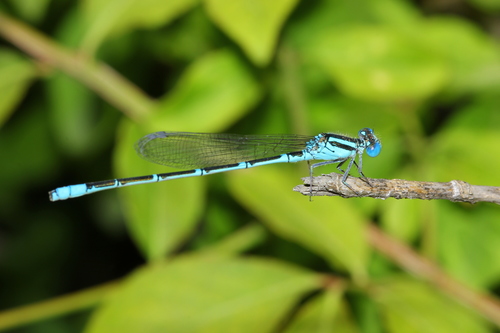
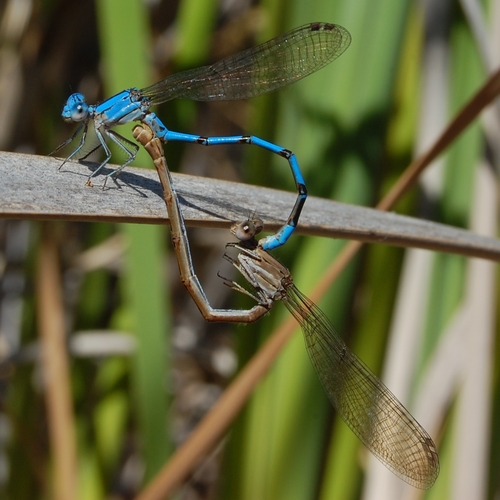
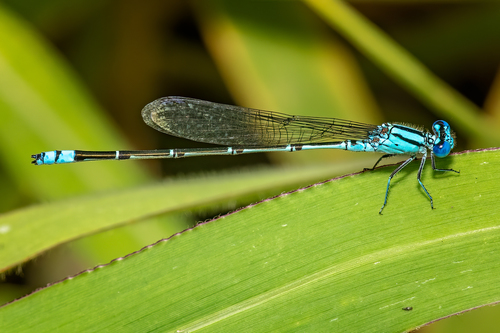
Pseudagrion microcephalum is a medium-sized damselfly. Males have pale blue eyes that are dark on the top, and reach a total length of 38mm. The male's thorax is azure blue, marked with broad black dorsal stripes and narrow black humeral stripes. The first and second abdominal segments are blue, with black markings on the dorsum; the marking on the second segment resembles a chalice or thistle-head. Abdominal segments 3 to 7 are black on the dorsum and blue on the sides. Segments 8 and 9 are blue; segment 8 has a thick black apical annule, and segment 9 has a thin black apical annule. Segment 10 is black on the dorsum and blue on the sides. The male's superior anal appendages are the same length as segment 10, are black, and are divided at the apices. Females have bluish green eyes and thorax, suffused with orange, with the same marking pattern as males, but orange replaces the black markings seen in males. The female's abdomen has a similar color pattern to the male's, but is paler. Female abdominal segments 8 and 9 are black with fine apical blue rings, and segment 10 is pale blue. Females range in overall color from blue-grey to grey-green. Pseudagrion microcephalum looks similar to the common bluetail and the eastern billabongfly. This species is distributed across the Australian states of New South Wales, Northern Territory, Queensland, Victoria and Western Australia. It is also found in southern Nigeria in Africa, and across Asia, including Bangladesh, China, Guangxi, Hong Kong, Hainan, Indonesia, India, Japan, Sri Lanka, Myanmar, Malaysia, Philippines, Peninsular Malaysia, Singapore, Thailand, Taiwan, and Viet Nam. Pseudagrion microcephalum is commonly found near both running and still water. Individuals usually rest on plants either in the middle of ponds or at water edges. It breeds in ponds, lakes and streams. It is strictly a species of the plains; in the neighboring hills of the Western Ghats of India and Sri Lanka, it is replaced by Pseudagrion malabaricum, and to the north-east of India and Burma it is replaced by Pseudagrion australasiae.