About Psathyrostachys juncea (Fisch.) Nevski
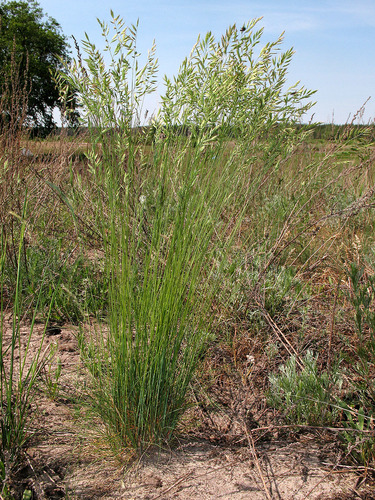
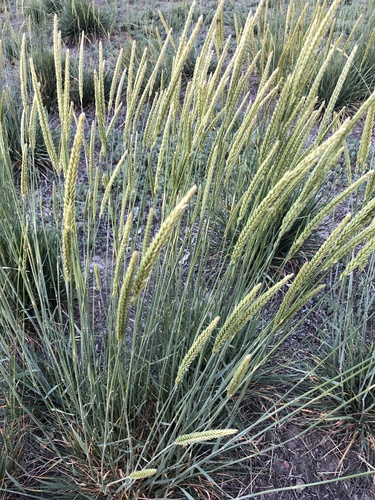
Psathyrostachys juncea is a perennial bunch grass that grows in tufts that may reach 1 metre (3.3 ft) in height or taller. This is a long-lived species, known to persist in cultivation for 25 years or more. Each clump produces a dense root network with no rhizomes or stolons, and its roots can reach 3 metres (9.8 ft) deep into soil. Its leaves grow around stem bases, and are either straight or curled; older leaf sheaths become shreddy. Its inflorescence is a spike measuring 11 to 16 centimetres (4.3 to 6.3 in) long. Psathyrostachys juncea was introduced to North America for use as a forage grass, for rangeland rehabilitation, and for soil stabilization. It is described as one of the most versatile forage grasses available for dryland pastures. It is palatable to livestock, but it does not produce good hay because of its basal leaf arrangement. It is also palatable to wild ungulates such as elk, and makes particularly good forage when planted in alternating rows with a legume like alfalfa. It is not generally invasive, and usually does not become a noxious weed; it rarely grows outside of plots where it has been planted. There are some known invasive occurrences in the Southwestern United States, including on the Grand Canyon plateaus. This species is drought-resistant, flood-resistant for most of the year, cold-tolerant, and tolerant of high soil salinity. It is not easy to establish from seed: if seeds are planted more than 1.9 centimeters deep, large numbers of seedlings will not emerge, and seedlings themselves are weak. Once established, however, the grass is tough and competes well for water and nutrients. It is also tolerant of fire: the dense clumping of its stems protects axillary buds, which can produce tillers and allow the grass to resprout after fire destroys its aboveground growth.