About Psathyrella ammophila (Durieu & Lév.) P.D.Orton
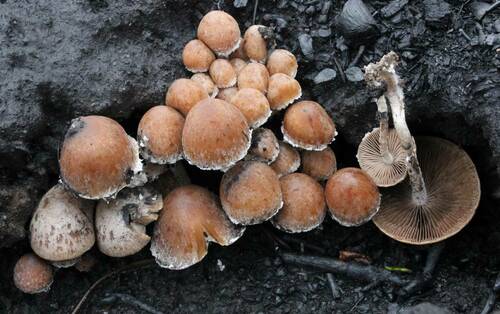
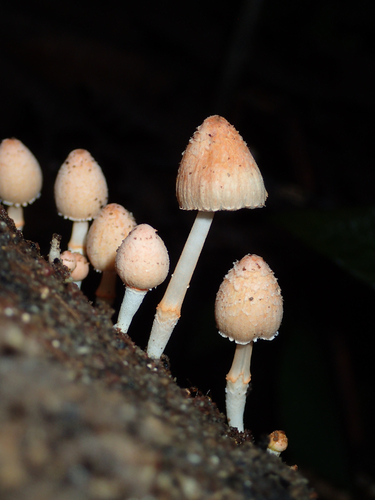
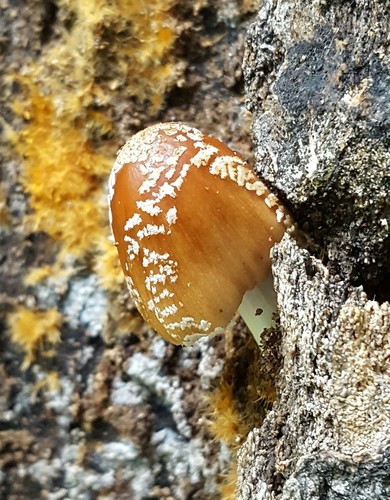
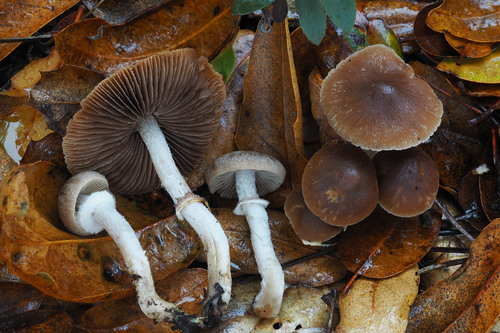
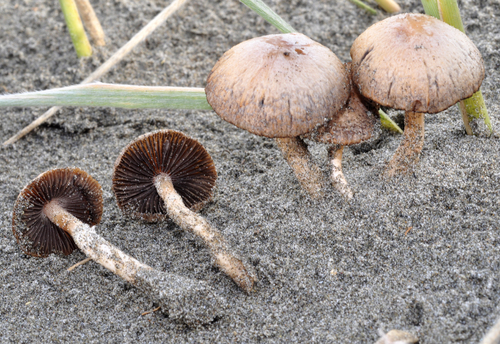
Psathyrella ammophila is typically a small- to medium-sized mushroom that grows terrestrially or in small clumps near marram grass. Young caps are light clay-brown or tan, and measure 1 to 4 centimeters (0.4 to 1.6 inches) in diameter. While caps are generally smooth to the naked eye, they have microscopically tiny hairs and are often coated with sand particles. The cap tissue is not hygrophanous, meaning it does not change color when it loses or absorbs moisture, but the entire mushroom darkens to dark brown as it ages. Caps start out campanulate (bell-shaped) or convex, then gradually flatten and may become depressed in the center. The gills of P. ammophila are crowded, and are attached to the stem, usually broadly (adnate) but occasionally narrowly (adnexed). Gills may be pallid brown when very young, but are dark brown for most of the mushroom's lifespan, and sometimes turn black. The stem (stipe) is light grey to pale brown, attached centrally to the cap. Its surface is smooth, and may sometimes have small vertical ridges. The stem grows deeply rooted into the substrate, both to feed on marram grass roots and to stay stable in its sand dune habitat. Above ground, the stem is typically 3 to 7 cm (1.2 to 2.8 in) tall, with a slender diameter of about 2 to 5 mm (0.08 to 0.20 in). There is no ring on the stem. Basidia produce four spores each. Spores are dark brown, smooth, ellipsoid, and measure 10 to 11 μm × 6 to 7 μm. Each spore has a large germ pore. The flesh of both the cap and stem is pale, thin, and brittle. Psathyrella ammophila has no distinctive taste or odor, and is classified as inedible, though it is not specifically noted to be toxic. The similar species Conocybe dunensis is mainly distinguished from P. ammophila by its rust-colored gills. Psathyrella ammophila has a wide but sparse distribution across the European continent, and is found in limited coastal locations outside of Europe, with collection records from Algeria, New Zealand, and Canada. It can sometimes be found near shorelines within the littoral zone, but it is most often encountered in more stable, established inland sand dunes and dune slacks. The presence of nearby marram grass is a key feature of its habitat, as P. ammophila has a commensal symbiotic relationship with these plants, using their decaying roots as a food source. The mushrooms grow either singly or in clumps, and are somewhat sympatric with the fly Delia albula. The fungivorous larvae of this fly develop parasitically inside P. ammophila, though they will also attack other fungi.