About Psammophilus dorsalis (Gray, 1831)
Head Morphology
This species of lizard, Psammophilus dorsalis, has a large, elongated, depressed head, with swollen cheeks in adult males. The snout is longer than the diameter of the orbit (eye cavity). Upper head scales are unequal and either smooth or obtusely keeled, and scales are larger on the sinciput (brow) than on the occiput.
Head Edge and Ear Features
The canthus rostralis and supraciliary brow have a clear, sharp edge. Two small separated spines or groups of spines above the ear may be either present or absent. The diameter of the tympanum is half, or slightly more than half, that of the orbit.
Labial Scales
This lizard has 10 to 13 upper labial scales, and the same number of lower labial scales.
Body Shape and Dorsal Scales
Its body is slightly flattened. Dorsal scales are small, uniform, and either smooth or feebly keeled in adults, while they are strongly keeled in young individuals. All dorsal scales point backwards and upwards.
Ventral and Midbody Scales
The dorsal crest is reduced to a ridge of enlarged scales. Ventral scales are the same size as dorsal scales, and are smooth (keeled in young individuals). There are 115 to 150 scales around the middle of the body.
Throat and Neck Features
Gular (under chin) scales are slightly smaller than ventral (underside) scales. Four or five enlarged scales sit on the chin parallel to the anterior labials, separated from the labials by two rows of scales. A strong transverse fold covered in small scales crosses the throat.
Body Crests
Nuchal and dorsal crests only form tooth-like protrusions.
Leg Characteristics
The legs are strong and covered in uniform, keeled scales. When the hind limb is extended forward on an adult specimen, it reaches the ear or the rear end of the eye; it reaches further forward in younger individuals.
Tail Morphology
The tail is slightly flattened and covered in keeled scales, which are larger on the underside than on the upper side. In adult males, the base of the tail is distinctly swollen, the scales on this swollen portion are thickened, and the scales of the upper median row are enlarged.
Juvenile and Female Coloration
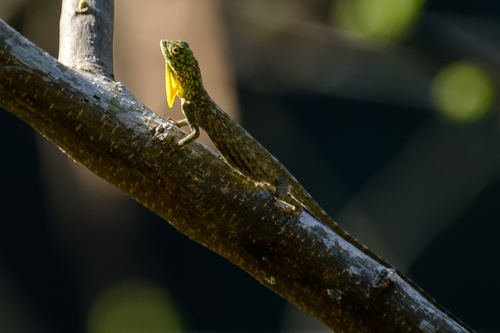
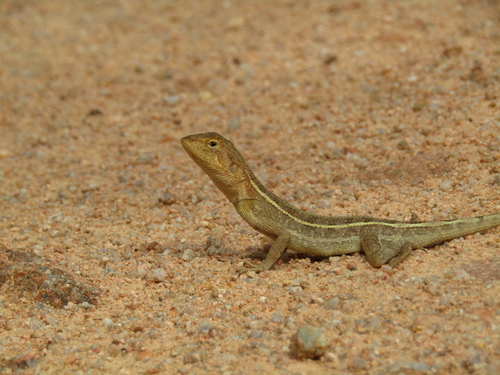
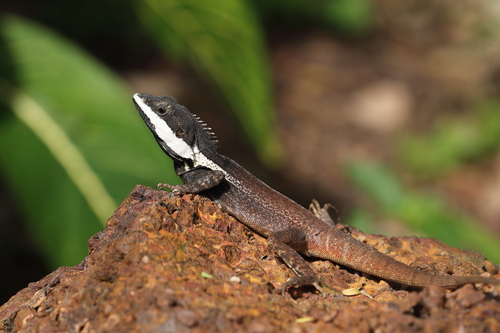
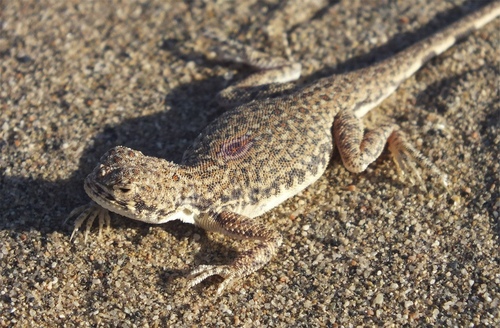
Young individuals and females are olive-brown, marked with dark brown spots, speckles, or marbling, and have a series of white, elongated spots along each side of the back.
Non-Breeding Male Coloration
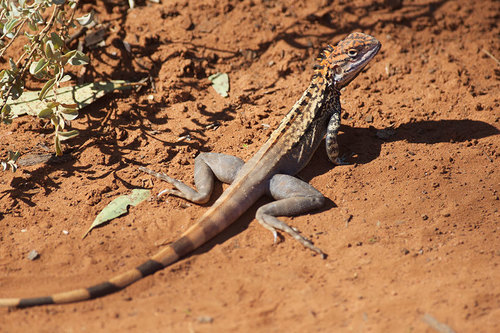
Breeding-non males have pale brownish colour on the top of the head and back; the lips are yellowish-brown, and this colour extends as a strip beyond the ear. A dark brown or black lateral stripe starts behind the eye and broadens to cover the lower sides. The underside is yellow, with the throat mottled with grey.
Breeding Male Coloration
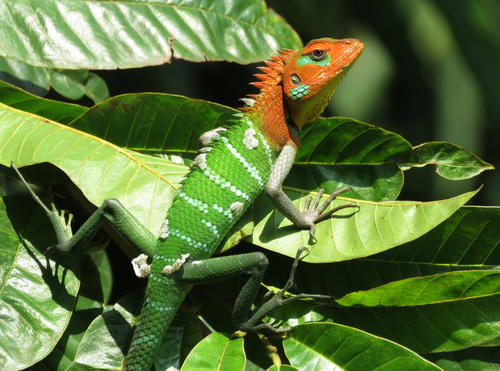
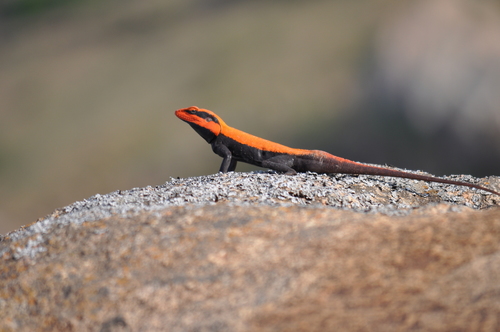
During the breeding season, adult males develop bright breeding colours: the upper parts become fine vermilion red or yellow, the lip stripe is sometimes pink, and the under surfaces, limbs, and tail turn black.
Behaviour and Diet
These lizards bask on bare rocks, where their cryptic colouration hides them. They feed on insects.
Size and Sexual Dimorphism
From snout to vent, adults reach 135 mm in length, and the tail reaches 200 mm. Females are smaller than males.
Geographic Range
This species is found in southern India, south of approximately 16°N latitude. It occurs in hilly regions of the Western Ghats, Nilgiris, South Arcot, and Nallamalai Hills, and can be found at altitudes up to 6000 ft above sea level in the Nilgiris.
Population Notes
It is very common in some parts of the Nilgiris, and M.A. Smith noted it as particularly common near Bangalore in The Fauna of British India.