About Prunus subcordata Benth.
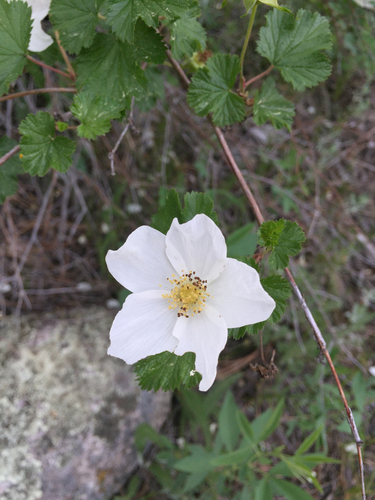
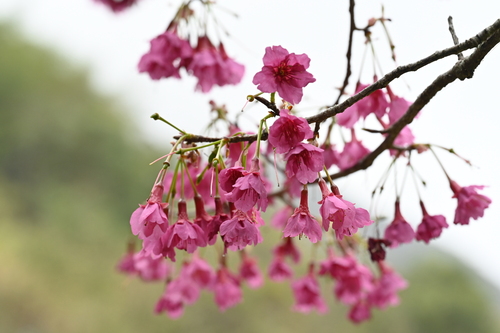
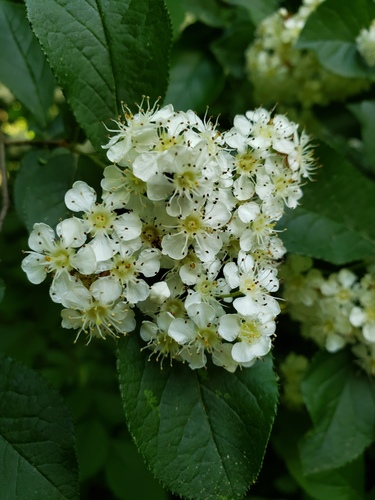
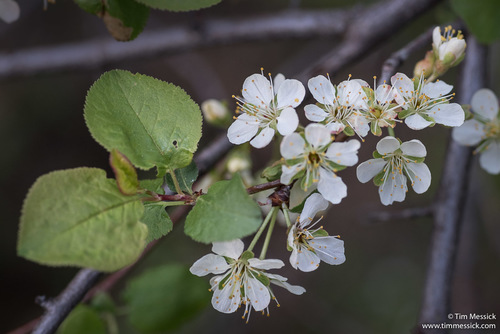
Prunus subcordata Benth. is an erect deciduous shrub or small tree that reaches 8 meters (26 feet) in height, with a trunk diameter of up to 15 centimeters (6 inches). It sprouts from its roots and can form dense, spiny thickets. Its bark is gray marked with horizontal brown lenticels, and looks similar to the bark of cultivated cherry trees. Its leaves are 2.5–6 cm (1–2+1⁄2 in) long, with a 4–15 millimeters (1⁄8–5⁄8 in) petiole; they are dark green, turn red before falling, and have faint teeth. Its flowers are white or pinkish, 2 cm across, and grow in clusters of 1 to 7, emerging in spring. The fruit is a small, plum-like drupe that varies in appearance, measuring 15–25 mm (5⁄8–1 in) in length, and may be red or yellow. The fruits mature in late summer, and are small and tart. This species is native to Northern California, and the central, western, and southern regions of Oregon. It grows in forests, most commonly at low elevations near the coast, but also occurs in the Sierra Nevada and Cascades, at altitudes ranging from 100–1,900 m (330–6,230 ft). The range of P. subcordata surrounds the San Joaquin Valley, particularly the western foothills of the Sierra Nevada range, but it does not grow in the coast mountains of the southwest San Joaquin Valley. Other Pacific coastal Prunus species include P. emarginata, which is also found in Pacific Northwest states; P. fremontii and P. ilicifolia are found in coastal or mountain areas of southwest California and northern Baja California. Various animals eat the fruit of P. subcordata and spread its seeds as a result. The fruit is considered edible.