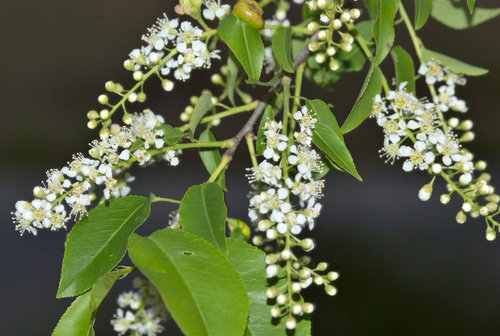
About Prunus serotina Ehrh.
Prunus serotina Ehrh., commonly called black cherry or rum cherry, is a medium-sized, fast-growing forest tree that reaches a height of 15–24 metres (49–79 feet). Its leaves are 5–13 centimetres (2–5 inches) long, ovate-lanceolate in shape, with finely toothed margins; they are long and shiny, resembling the leaves of sourwood. In autumn, leaves turn from yellow to red. The tree produces small, white, 5-petalled flowers arranged in 10–15 cm (4–6 in) long racemes that each hold several dozen flowers. After flowering, it develops 5–10 millimetres (1⁄4–3⁄8 in) diameter reddish-black drupes, commonly called berries, which are eaten by birds. For its first approximately ten years of growth, a black cherry tree has thin, smooth, banded bark that looks similar to birch bark. Mature trees have very cracked, dark gray to black bark. When a young twig is scratched and smelled, it releases an almond-like odour; this comes from trace amounts of cyanide compounds the plant produces and stores to defend itself against herbivores. This species is widespread and common across North America and South America. Prunus serotina is a pioneer species. In the North American Midwest, it grows mostly in old fields alongside other sunlight-loving species such as black walnut, black locust, and hackberry. Gleason and Cronquist (1991) describe P. serotina as "[f]ormerly a forest tree, now abundant as a weed-tree of roadsides, waste land, and forest-margins". It is a moderately long-lived tree, with recorded individuals reaching 258 years of age. It is prone to storm damage, as its branches break easily, but any decay that results from this breakage progresses slowly. The tree begins producing fruit around 10 years of age, but does not produce heavy fruit crops until it reaches 30 years old, and continues fruiting up to 100 years of age or more. It has high germination rates, and its seeds are widely dispersed by birds and bears that eat the fruit then excrete the seeds. Some seeds may remain in the soil seed bank and not germinate for up to three years. All Prunus species have hard seeds that benefit from scarification to germinate; in natural settings, this scarification occurs when seeds pass through an animal's digestive tract. The tree is hardy, and can tolerate poor soils and oceanic salt sprays. P. serotina is a host plant for the caterpillars of more than 450 species of butterflies and moths. These include the eastern tiger swallowtail (Papilio glaucus), cherry gall azure (Celastrina serotina), viceroy (Limenitis archippus), and red-spotted purple/white admiral (Limenitis arthemis) butterflies, as well as the cecropia (Hyalophora cecropia), promethea (Callosamia promethea), polyphemus (Antheraea polyphemus), small-eyed sphinx (Paonias myops), wild cherry sphinx (Sphinx drupiferarum), banded tussock (Halysidota tessellaris), spotted apatelodes (Apatelodes torrefacta), and band-edged prominent moths. Deer feed on the tree's foliage. Prunus serotina subsp. capuli was cultivated in Central and South America long before European contact. Known as capolcuahuitl in Nahuatl, which is the source of the subspecies epithet capuli, it was an important food source in pre-Columbian Mexico. Native Americans ate the fruit of this species. The fruit is edible raw, and is also made into jelly; its juice can be used as a drink mixer, which is the origin of the common name 'rum cherry'. The timber of Prunus serotina is valuable, and is traded simply as "cherry"; it is considered one of the premier cabinetry timbers of the United States. High quality cherry timber is known for its strong orange hues, tight grain, and high market price. Low-quality wood, along with sapwood, tends to be more tan in colour. Dried Prunus serotina wood has a density of approximately 560 kg/m3 (35 lb/cu ft). Prunus serotina was widely introduced into Western and Central Europe as an ornamental tree in the mid-20th century, where it has become locally naturalized. It has acted as an invasive species there, negatively impacting forest community biodiversity and tree regeneration.