About Prunus salicina Lindl.
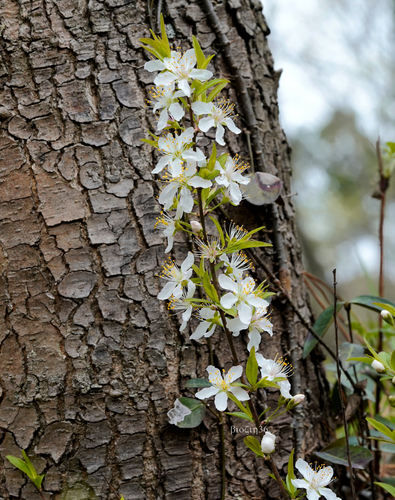
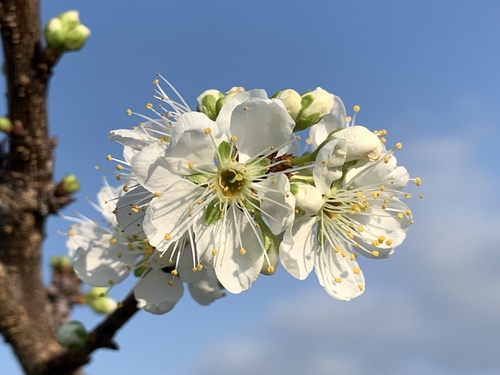
Prunus salicina Lindl. is a deciduous tree that reaches 9–12 metres (30–39 ft) in height. Its branches range from purplish brown to reddish brown, and its lateral shoots are yellowish red. Leaves measure 6–12 cm long and 2.5–5 cm broad, with scalloped margins that often include simple gland-tipped teeth when young. Leaf shape is typically oblong, but sometimes varies to be more obovate (broader above the middle), narrowly elliptic, or rarely slightly ovate (broader half below the middle). The leaf base is wedge-shaped, and the leaf apex ranges from acute (pointed) to caudate (with a slender short tail). The upper leaf surface is dark green, glossy, and has 6 or 7 secondary veins on either side of the midvein, which do not extend to the leaf margin. The species' winter buds are purplish red, and only rarely have fine hairs along their scale margins. Flowers emerge in early spring, around April, growing in clusters of 3. Each flower is around 2 cm in diameter with five white petals. Flower pedicels measure 1–1.5 cm. Sepals are oblong-ovate, around 5 mm long, hairless on the outside, and have loosely serrated margins; their apex ranges from acute to obtuse. Petals are white and oblong-obovate, with a wedge-shaped base and a jagged margin near the apex. The ovary is hairless, and the stigma is disc-shaped. The fruit is a drupe that ripens from July to August. It ranges from 3.5–5 cm in diameter, reaching 7 cm in diameter in horticultural forms, and can be spherical, egg-shaped, or conical in shape. The fruit skin can be yellow, red, sometimes green or purple, and has a powdery coating, while the flesh is yellow-pink. Fully ripe Prunus salicina fruit can be eaten raw. Compared to Prunus domestica (European plum), Prunus salicina fruit has stronger flavor and aroma, better texture, more intense color, larger size, and good nutritional value. The fruit's pit is ovoid (egg-shaped) to oblong, and has a wrinkled surface. Prunus salicina is native to China, Taiwan, Myanmar, Laos and Vietnam. In China, it grows in sparse forests, forest margins, thickets, along mountain trails, and beside valley streams, at elevations between 200 and 2600 meters. It grows best in warm temperate regions, as it requires moderate temperatures and typically flowers early. Its domestication center of origin is southwestern China's Yangtze River Basin. Thriving wild populations are reported in China's Shaanxi and Gansu provinces. It has been recorded as an introduced species in Australia and Japan. Like other plum species, Prunus salicina is strongly dependent on endomycorrhizal relationships. Ectomycorrhizal relationships with the fungus Hebeloma hiemale have been shown to increase net growth in the hybrid Prunus cerasifera x salicina, compared to growth with chemical fertilizer, compost, or in a control group. Studies of this species' ability to improve soil in karst areas of China have produced mixed results. A study at Guiyang Karst Park in Guizhou, China, concluded that Prunus salicina, when grown alongside the mosses Homomallium plagiangium, Cyrto-hypnum pygmaeum, and Brachythecium perminusculum, and the herbs Veronica arvensis and Youngia japonica, is a suitable pioneer species to cultivate for restoration of karstic soil erosion areas. When planted on cropland affected by rocky desertification in the city of Hechi, Prunus salicina increased the carbon-to-nitrogen ratio and improved soil quality in the 10–20 cm deep soil layer. Overall, however, it had limited positive effects on soil improvement, because its fast growth and high yield lead to greater absorption of soil nutrients. Like other stone fruits, Prunus salicina pits and leaves are poisonous to humans. They contain amygdalin, which breaks down into hydrogen cyanide. Poisoning from unintentional ingestion of a small number of pits is unlikely, but ingestion is not recommended, and crushed pits should never be consumed. Prunus salicina is commonly known as Japanese plum, and is widely cultivated. China is the top producing country, followed by the United States, Mexico, Italy, Spain, Pakistan, Korea, Australia, Chile, France, South Africa and Argentina. The most famous variety grown in Vietnam is the Tam Hoa plum, cultivated in Bắc Hà town, Lào Cai Province. Japanese cultivars were introduced to the United States in the second half of the 19th century, and subsequent breeding produced many new cultivars, generally with larger fruit. Plant breeder Luther Burbank developed many cultivars by hybridizing Prunus salicina with Prunus simonii and other native North American diploid plums including Prunus americana, Prunus hortulana, and Prunus munsoniana. In the late 19th and early 20th centuries, Burbank selected cultivars from these hybridizations including 'Beauty', 'Eldorado', 'Formosa', 'Gaviota', 'Santa Rosa', 'Shiro', and 'Wickson', some of which are still widely grown today. The famous 'Santa Rosa' cultivar is named for the California city where it was developed. Most fresh plums sold in North American supermarkets are Prunus salicina cultivars or hybrids. The species is grown on a large scale in many other countries; for example, it dominates the stone fruit industry in Western Australia. In 2020, production volume of Japanese plums in France was higher than that of European plums. Breeding and selection programs for new Japanese plum cultivars operate around the world. Between 1995 and 2021, the European Union's Community Plant Variety Office registered 155 new Japanese plum cultivars. In Traditional Chinese medicine, Prunus salicina fruit is used to boost immunity against infectious agents and to treat cancers. The 'Crimson Globe' Japanese plum cultivar can be consumed as an antioxidant source with potential to counteract oxidative damage. Prunus salicina fruit may contain immunostimulatory components that could be useful in human and veterinary medicine. Compared to other fruits, Japanese plums are a reasonable source of fiber and a good source of bioactive compounds, including vitamin C and phenolic compounds. Their phenolic content correlates positively with their antioxidant properties. A study evaluating ethanol extracts from 400 herbs found that Japanese plum was the most effective glucosyltransferase (GTF) inhibitor, and showed the highest antibacterial activity. Research has investigated whether Japanese plum fruit has cancer-protective effects due to its antioxidant properties, but as of 2023, the role that antioxidants in general play in cancer prevention and treatment remains unclear.