About Prunus prostrata Labill.
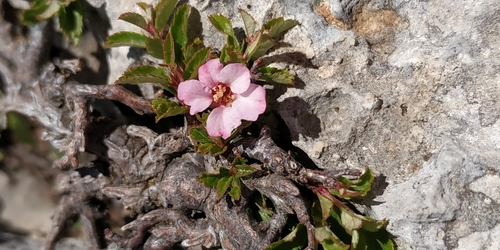
Prunus prostrata Labill., commonly known as mountain cherry, rock cherry, creeping cherry, spreading cherry, or prostrate cherry, is a hardy alpine shrub. Its natural range spans elevations from approximately 2000 m up to 4000 m across Spain, France, Algeria, Morocco, Tunisia, Albania, Croatia, Greece, North Macedonia, Sardinia, Turkey, and Syria. It reaches a maximum height of 1 m, though most individuals grow between 0.15 and 0.30 m tall, and sometimes grows within crevices of vertical rock surfaces. Its branches tend to grow along any angled surface they encounter. Flowering patches of this shrub on rocky, sometimes still snow-covered slopes are a notable sight for climbers. Its bark is reddish brown. Leaves are ovate with serrated edges; the underside is covered in white downy tomentum, while the upper surface is glabrous. The leaf petioles do not have glands. The flowers are an unusual light rose color, bloom from April to May, and grow singly or in pairs. They are nearly sessile and have a tubular calyx, with 22 to 24 stamens per flower. The fruit is red and ovate, with thin flesh, and ripens in July. The fruit is edible, but is not favored for human consumption. The primary use of Prunus prostrata is as an ornamental garden plant, and it can be grafted to grow into a full-sized tree.