About Prunus persica (L.) Stokes
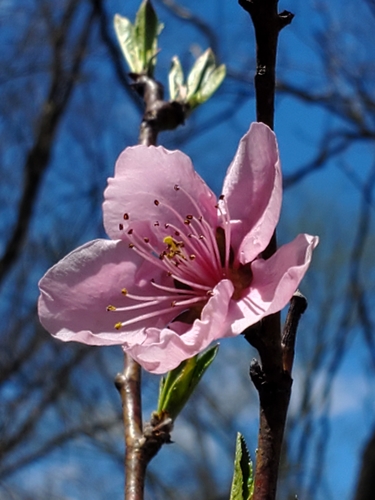
Prunus persica, the peach, is a deciduous tree or tree-like shrub. It very rarely grows as tall as 10 meters (33 ft), but is more typically 3 m (10 ft) tall, with large specimens reaching 4 m (13 ft). The spread of its crown matches its height range, growing 3–4 m (9.8–13.1 ft) across. Peach plants do not produce suckers or have thorns, and they have a deep root system that continues growing through the winter. Unlike apple trees, peach trees are generally not sized for commercial orchards using dwarfing rootstocks. Many different growth habits have been selected through cultivation, including columnar, dwarf, spreading, and weeping. Pruning is required to grow trees with a single trunk, and branches naturally droop over time, so they must be trained to keep space accessible under the tree. The bark of the trunk and branches is dark gray with horizontal lenticels, and becomes more scaly and rough as the tree ages. Young peach twigs have a smooth, hairless surface, with red bark that is green on the portions not exposed to sunlight. As branchlets age, they weather to a gray color, and twigs develop true terminal buds at their ends. Peach leaves are oblong to lanceolate, with roughly parallel sides until tapering at the base and tip, or shaped like a spear head. The widest section of the leaf is at the midpoint or further toward the tip. Each leaf folds along its central midrib and is often curved; they are usually 7–15 centimeters (3–6 in) long and 2–4.5 cm (1–2 in) wide, though they may occasionally be shorter. Leaf surfaces are smooth and hairless, but the leaf stem sometimes has glands. Leaf edges are serrated with blunt teeth, and each tooth has a reddish-brown gland at its tip. Leaves attach to twigs via strong petioles (leaf stems) that measure 1 to 2 cm long, and these petioles can also bear one or more extrafloral nectaries. The exact origin of the domestic peach is unknown. Archaeological work from the 2010s identifies East China near the Yangtze Delta as the most likely candidate for its domestication, contradicting the earlier theory that it was domesticated in Northwestern China; many sources published since the 1980s have listed North China as its likely place of origin. Today, peaches are naturalized across many parts of Asia. They grow throughout eastern China and into Inner Mongolia, east to the Korean Peninsula and Japan, and south to Vietnam and Laos. In the Indian subcontinent, they are reported in the Eastern Himalayas and nearby Assam province (but not Nepal), parts of central India, Pakistan, and the Western Himalayas. Further west, they are an introduced species in Afghanistan, Iran, and all countries of Central Asia, and they grow in the North Caucasus, Transcaucasia, and Turkey before extending into Europe. In Europe, peach trees are partly naturalized: they are found in Portugal, Spain, France, Ireland, and the United Kingdom in western Europe; reported as escaped from cultivation in Germany, Hungary, and Switzerland in central Europe, and in Corsica, Sardinia, Italy, Cyprus, and Greece in southern Europe; growing as introduced plants in Slovenia, Croatia, Romania, and Bulgaria in the southeast; and found in parts of European Russia, Ukraine, and Crimea to the east. Peaches have also escaped cultivation in the African nations of Libya, Ethiopia, Kenya, South Africa (specifically the Northern Provinces, Orange Free State, and KwaZulu-Natal biogeographic areas), and the Cape Verde Islands off northeast Africa. In North America, besides cultivation, peach saplings often grow anywhere peach pits have been discarded. Most of these feral trees are short-lived, but some have established naturalized populations. Escaped populations are reported in the Canadian provinces of Ontario and Nova Scotia. In the United States, trees growing outside cultivation have been found in all areas east of the Mississippi except Minnesota, Vermont, and New Hampshire; in the Pacific Northwest, they are found in Oregon and Idaho; in the Southwest, they are somewhat naturalized from California to Texas, excluding Nevada. Similar established escaped populations also occur in northwestern Mexico and El Salvador in Central America. In South America, escaped peach trees are only reported from Ecuador and northeastern Argentina. In Australia, the peach is naturalized in the states of New South Wales, Queensland, Victoria, South Australia, and Western Australia. In New Zealand, it is found as an escape from cultivation on both the North Island and South Island, especially around Auckland, Christchurch, and in the Otago region. It is also naturalized on many oceanic islands, including the Mariana Islands, Mauritius, Rodrigues, Réunion, and Saint Helena.