About Prunus padus L.
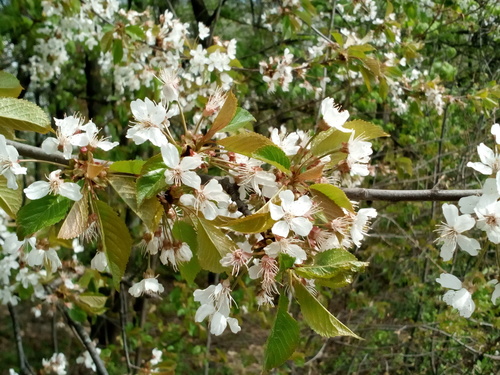
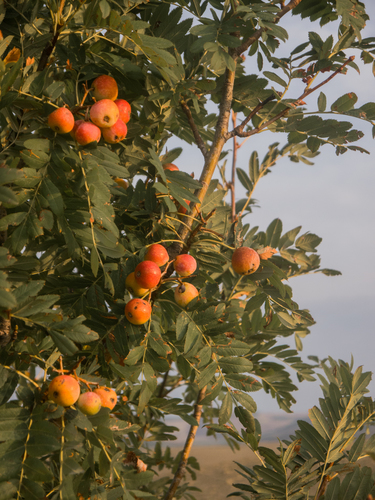
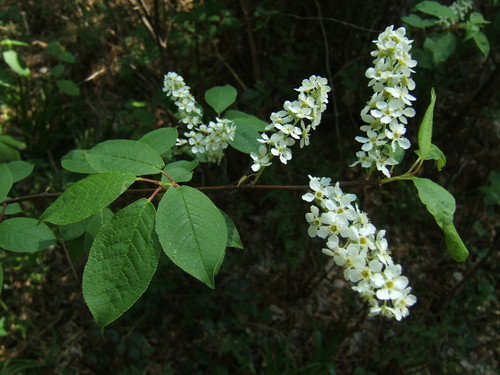
Prunus padus L. has astringent fruit due to its tannin content. Fruits persist for an average of 12.8 days, and each fruit always contains a single seed. On average, fruits are 78.4% water; the dry weight of fruit is made up of 31.3% carbohydrates and 1.3% lipids. There are two recognized varieties: Prunus padus var. padus (European bird cherry), native to Europe and western Asia, and Prunus padus var. commutata (Asian bird cherry), native to eastern Asia. Prunus padus is native to Morocco and temperate Eurasia, ranging from the British Isles to Japan. Its native range covers all of Western and Central Europe north of the Pyrenees and the Alps, and south of the treeline, with small isolated populations also found in Iberia, Northern Italy, and parts of North Africa. It also grows throughout all of Eastern Europe north of the Balkan Mountains and the Steppe, as well as in the Caucasus. In Asia, it occurs across the forests of Siberia, Mongolia, the Russian Far East, Korea, and Hokkaido, and is found in parts of China with isolated populations in the Himalayas. It is an invasive species in Alaska, where eradication efforts are underway. The flowers of Prunus padus are hermaphroditic, and are pollinated by bees and flies. The fruit is readily eaten by birds, which do not find its astringency unpleasant. In Eurasia, the bird-cherry ermine moth (Yponomeuta evonymella) uses Prunus padus as a host plant, and its larvae can completely defoliate entire individual trees. In North America, this tree is often attacked by black knot fungus. Some parts of Prunus padus, including its leaves, stems and fruits, contain the glycosides prulaurasin and amygdalin, which can be poisonous to some mammals. The fruit of this tree is seldom used for food in western Europe, but it may possibly have been used as food in far eastern regions long ago. In Russia, the fruit of the tree is still used for culinary purposes. Dried berries are milled into flour of variable fineness, which is the main ingredient in bird-cherry cake. Both the flour and the resulting cake are brown, even though the cake contains no chocolate. Both the flour and the finished cake are sold in local stores and bakeries. Fresh bird cherries can also be prepared in a more conventional way, by mincing and cooking them to make jam. The variety commutata is sold as an ornamental tree in North America under the common name Mayday. It is valued for its hardiness and its spring display of fragrant, white flowers. The common name Mayday tree comes from the May Day festival, and is unrelated to the "mayday" distress signal. The tree name was already in use before "mayday" (the phonetic equivalent of the French m'aider, from venez m'aider meaning "come help me") was adopted as the international distress signal.