About Prunus nigra Aiton
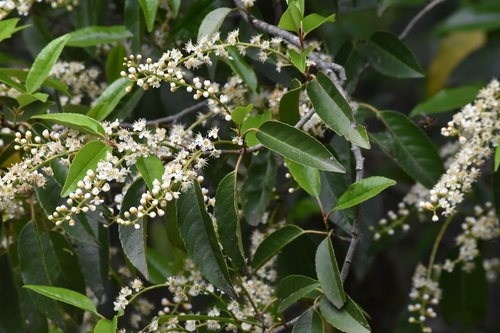
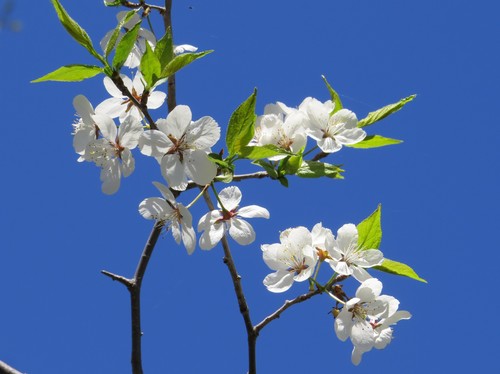
Prunus nigra Aiton is a deciduous shrub or small tree that grows up to 10 metres (33 feet) tall, with a trunk up to 25 centimetres (10 inches) in diameter. It forms a low-branched, dense crown made up of stiff, rigid branches. Its bark is gray-brown, and older bark layers peel away in thick plates. New branchlets start out bright green, later turning dark brown with a red tinge, and they become spiny. The winter buds are chestnut brown, long-pointed at the tip, and reach up to 8 millimetres (3⁄8 inch) long. The leaves are alternate, simple, and oblong-ovate or obovate, measuring 5–12 cm (2–4 3⁄4 in) long and 3–7 cm (1 1⁄8–2 3⁄4 in) broad. Leaf bases can be wedge-shaped, slightly heart-shaped, or rounded; leaf edges are doubly crenulate-serrate, with blunt, gland-tipped teeth, and leaves end abruptly in a narrow point at the apex. Leaves are feather-veined with a conspicuous midrib. When they first emerge from buds, they are folded convolute, downy, and slightly tinged red; when fully grown, they are smooth, bright green on the upper surface, and paler beneath. Leaf petioles are stout, and bear two large dark glands plus early deciduous, lanceolate, three to five-lobed stipules. Flowers measure 15–25 mm (5⁄8–1 in) across, and have five rounded petals that are white before fading to pale pink, with more or less irregularly notched margins. The flowers are slightly fragrant, produced in 3 to 4-flowered umbels with short, thick peduncles, and emerge before the leaves in mid to late spring. Flower stalks are slender and dark red. The calyx is conical, dark red, five-lobed; the lobes are acute, eventually reflexed, glandular, and smooth on the inner surface, and the lobes are ovate with short claws, imbricate in bud. There are 15–20 stamens inserted on the calyx tube, with thread-like filaments and purplish, introrse, two-celled anthers that open longitudinally. The pistil holds a superior ovary at the base of the calyx tube, which is single-celled and contains two ovules. The fruit is an oblong-oval drupe, 25–30 mm (1–1 1⁄8 in) long, with tough, thick orange-red skin that has no natural waxy bloom. Its yellow flesh adheres to the oval, compressed stone. The fruit matures in late summer or early autumn. The species has thick, fleshy cotyledons, and grows best in alluvial soils. It is closely related to Prunus americana, and can easily be confused with that species; it differs most obviously by the blunt, gland-tipped teeth on its leaf margins, compared to the sharp, glandless teeth on P. americana leaves. Prunus nigra ranges from Nova Scotia west to Minnesota and southeastern Manitoba, and south to Connecticut, Illinois, and Iowa. It formerly occurred in Ohio, but it is now thought to be extinct there. Isolated populations grow along streambanks in Saskatchewan and Alberta, along Lake Timiskaming in Northern Ontario, and along the Maine-New Brunswick border. The isolated population along the Maine-New Brunswick border is severely threatened, because P. nigra acts as a host for an aphid that damages the local potato crop, and many of these trees have been cut down to control the pest. A fungus from the genus Taphrina often infects these plums: the young ovaries swell to become much larger than fully grown plums, turn hollow, and often stay attached to the tree through winter. This infection is called "plum pockets"; the swollen growths are pale green, leathery to the touch, and hollow except for a small amount of fibrous tissue. The disease reduces the production of viable Prunus nigra fruit. The fruit is somewhat sour, clingstone, and very juicy. It can be eaten raw when fully ripe, or cooked to make pies, preserves, and jellies. Dried P. nigra plums were a popular winter staple for indigenous peoples. French explorer Jacques Cartier noted in his journal that St. Lawrence Iroquoians gave him dried Canada plums during his first expedition to Canada. Early settlers in the western U.S. and Canada also used these wild plums as dried fruit; this use was popularized by the autobiographical novel On the Banks of Plum Creek, the fourth book in Laura Ingalls Wilder's Little House on the Prairie series. As one of the few tree fruits native to the Upper Midwest of the U.S., Northern Ontario and the prairie provinces of Canada that can survive the region's harsh winters, 19th century efforts were made to breed improved cultivars of these plums. Notable varieties that are still cultivated today include "Assiniboine" and "Cheney". P. nigra has the same number of chromosomes as Prunus salicina, the cultivated Japanese plum, so the two species cross-pollinate easily. 20th century breeding work produced improved P. nigra x salicina hybrid varieties that combine the high fruit quality of Japanese plums and the cold hardiness of wild Canada plums; examples include "Pembina", "Superior", and "Patterson Pride". The wood of P. nigra is bright red brown, heavy, hard, strong, and close-grained, with a density of 0.6918. When the tree is wounded, the wood turns an attractive red shade, and sawlogs from intentionally wounded trees are sought after by woodturners.