About Prunus maximowiczii Rupr.
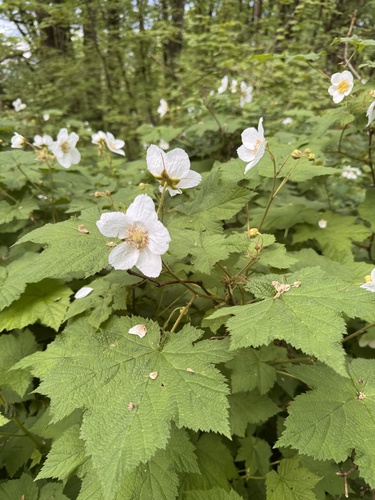
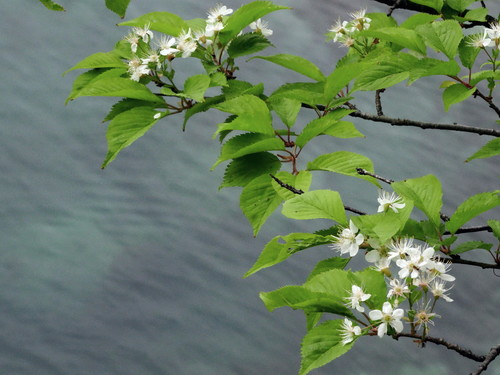
Prunus maximowiczii Rupr. produces white, insect-pollinated, hermaphroditic flowers. In the Northern Hemisphere, these flowers bloom in May; in the Southern Hemisphere, they bloom in November. Its edible fruits, commonly called cherries, are roughly 5 mm in diameter, with each fruit holding one large seed. The fruits ripen in August in the Northern Hemisphere, and in February in the Southern Hemisphere. This species is naturally distributed across Korea, China (the provinces of Heilongjiang, Jilin, Liaoning, and Zhejiang), Russia (the regions of Khabarovsk, Primorye, and Sakhalin), and Japan (the islands of Hokkaido, Honshu, and Kyushu). It most often grows in mountainous woodland areas, and in clayey soil. Prunus maximowiczii has multiple uses. In addition to being eaten directly, its fruits are not the only usable part: the flowers can be preserved in brine and used as a condiment. The wood of this species is very hard, heavy, and close-grained, which makes it excellent for carving and furniture production. Green dyes can be made from its leaves, while dyes produced from its fruit range from dark grey to green. Compounds that can be extracted from Prunus maximowiczii include amygdalin, prunasin, and genistein; derivatives of amygdalin and prunasin produce prussic acid.