About Prunus mahaleb L.
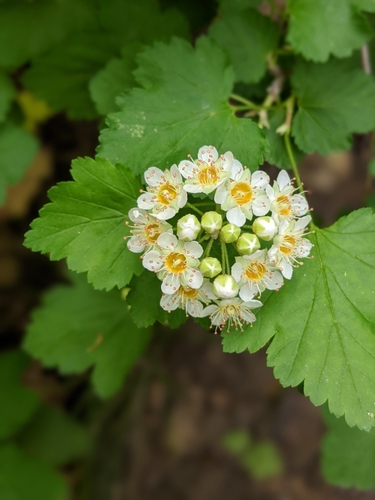
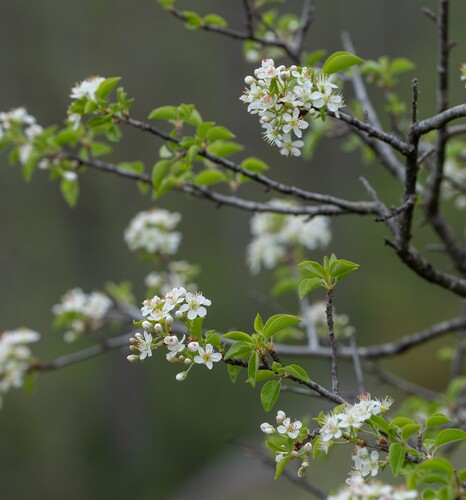
Prunus mahaleb L. (mahaleb cherry) is a deciduous tree or large shrub, growing 2–10 m tall, and rarely reaching up to 12 m. Its trunk can grow up to 40 cm in diameter. The bark is grey-brown; young stems have prominent, visible lenticels, while the bark of old trunks is shallowly fissured. Leaves are 1.5–5 cm long and 1–4 cm wide. They grow in an alternate arrangement, are clustered at the ends of alternate twigs, and range from ovate to cordate in shape, with a pointed tip, serrated edges, and longitudinal venation. The leaves are green and hairless. The petiole is 5–20 millimetres long, and may or may not have two glands. The small, fragrant pure white flowers are 8–20 mm in diameter, each held on an 8–15 mm pedicel. 3 to 10 flowers grow together on a 3–4 cm long raceme. Flowers are primarily pollinated by bees. The fruit is a small thin-fleshed cherry-like drupe, 8–10 mm in diameter. It starts green, then turns red, and finally dark purple to black when fully mature, and has a very bitter flavour. The plant flowers in mid spring, and fruit ripens from mid to late summer. This species exhibits selective fruit abortion: it produces a large proportion of excess flowers that lead to low overall fruit set levels. This process reduces the number of poor quality fruit, and increases the viability of its remaining seeds. Prunus mahaleb grows in thickets and open woodland on dry slopes. It is found in central Europe at altitudes up to 1,700 m (5,600 ft), and in southern European highlands at 1,200–2,000 m. It has become naturalised in many temperate areas outside its native range, including Europe north of its native area (as far north as Great Britain and Sweden), and occurs locally in Australia and the United States. A scientific study found an ecological dependence between Prunus mahaleb and four species of frugivorous birds in southeastern Spain, with blackbirds and blackcaps being the most important seed dispersers for the species. When P. mahaleb produces fruit, these birds consume its fruit almost exclusively, and disperse the tree's seeds to locations that are favourable for P. mahaleb growth. The way some birds consume the fruit, and the habitats these birds use, may act as a selective force that shapes which genetic variations of this cherry thrive. Outside of its native range, Prunus mahaleb is grown as an ornamental tree in temperate regions worldwide, valued for its strongly fragrant flowers. Several cultivars have been selected for ornamental use: 'Albomarginata' has variegated foliage, 'Bommii' is a dwarf with strongly pendulous branches, 'Globosa' is a compact dwarf clone, 'Pendula' has drooping branches, and 'Xanthocarpa' produces yellow fruit. It is also used as a rootstock for grafting other types of cherry trees. The species is cultivated to produce mahleb, a spice made from the seeds inside its cherry stones. This fragrant spice has a bitter almond flavour, and is used in small quantities to enhance the flavour of sweet foods, including the Turkish sweet-bread çörek (chorak), the Greek sweet-bread tsoureki, and the Armenian sweet-bread chorak. While its full chemical composition is still uncertain, the spice is prepared either by grinding the seed kernels into powder, or by extracting oil from the seeds. The wood of Prunus mahaleb is hard, and is used for cabinet-making and for making pipes. The bark, wood, and seeds contain coumarin, and have documented anti-inflammatory, sedative, and vasodilation effects.