About Prunus lusitanica L.
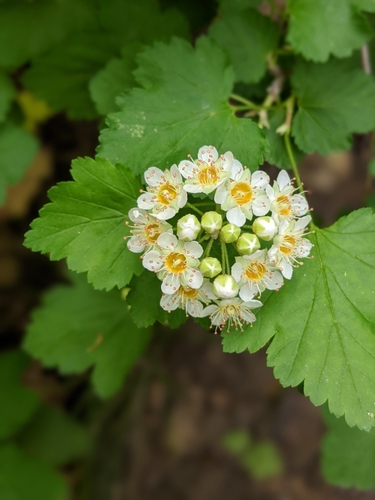
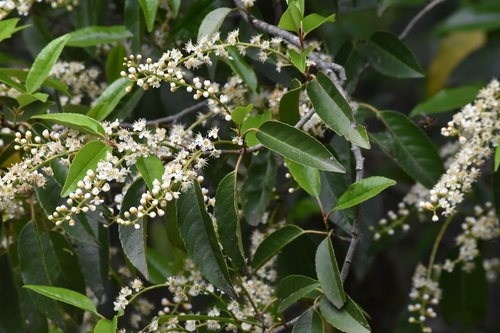
Prunus lusitanica L. is an evergreen shrub or small tree. It normally grows 3 to 8 meters tall, though cultivated specimens can reach 15 to 20 meters in height. It has smooth, dark-grey bark. Its leaves are alternate and oval-shaped, measuring 7–15 cm long and 3–5 cm broad, with an acute apex and a dentate margin. The upper leaf surface is glossy dark green, while the lower surface is lighter in color. These leaves look very similar to the leaves of bay laurel, so the species is often mistaken for bay laurel. Its flowers are small, 10–15 mm in diameter, with five small white petals. The flowers grow on erect or spreading racemes 15–25 cm long, and bloom in late spring. Its fruit is a small cherry-like drupe 8–13 mm in diameter. It starts out green or reddish green, and ripens to dark purple or black in late summer or early autumn. It is native to the western Mediterranean Basin, including France, Spain, and Portugal, and to Macaronesia, including the Azores, Canary Islands, and Madeira. It is rare in the wild, and is mainly found growing along mountain streams. It prefers sunny conditions and moist but well-drained soils, and is moderately drought-tolerant. It can reproduce either sexually, which is its most successful reproduction method, or asexually by cloning from shoots. The leaves of Prunus lusitanica contain cyanide, which will be released into the environment if the leaves are burnt or crushed. Fully ripe fruit is somewhat edible, but if the fruit is bitter it is toxic and should not be eaten. Prunus lusitanica is grown as an ornamental shrub, and is widely planted as a hedge and for screening in gardens and parks. It has been introduced and is locally naturalised in the temperate zone of northern France, Great Britain, Ireland, New Zealand, western Canada (including the southern BC Mainland and Vancouver Island from Victoria north through Cowichan, Nanaimo and Parksville), and the western United States in California, Oregon, and Washington State. Like its relative Prunus laurocerasus, P. lusitanica has been classified as invasive by some botanists and land managers in western Washington and Oregon. Birds eat its fruit and defecate its seeds away from the original parent plant, allowing the species to spread from cultivated areas into natural areas. It has received the Royal Horticultural Society's Award of Garden Merit.