About Prunus geniculata R.M.Harper
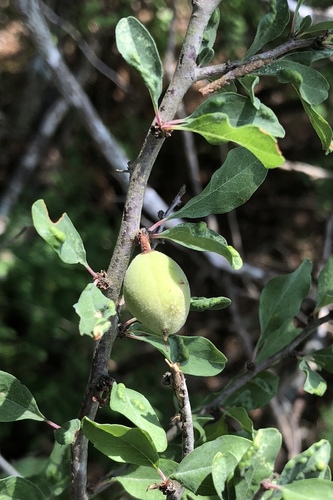
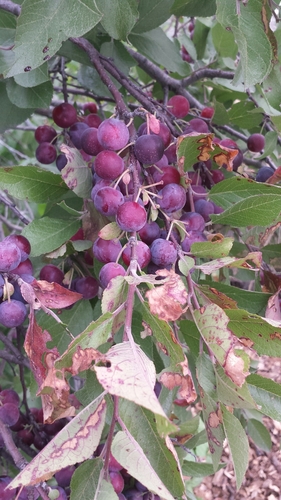
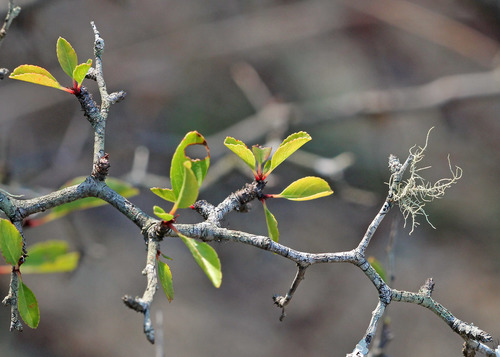
Prunus geniculata R.M.Harper is a low, rounded shrub with a gnarled trunk that emerges from sand. It branches densely to form a mound that can reach up to two meters in height. Its sharp-tipped branches grow in a zig-zagging, angled pattern; they are sometimes buried in sand, and when they emerge, they are covered in lichens. The plant's gray bark cracks to reveal new reddish brown bark underneath. Its alternately arranged leaves have smooth blades 1 to 3 centimeters long, with wavy or toothed edges. Blooming occurs before new leaves appear. Flowers are usually solitary, with five red sepals, five white petals a few millimeters long, and many stamens with yellow anthers at the center. This species is andromonoecious, meaning individual plants bear both bisexual flowers and male-only flowers. The fruit is a bitter-tasting, egg-shaped reddish purple drupe that grows up to 2.5 centimeters long. This plant may grow alone or in colonial groups. Little is known about its overall life history. This species is endemic to Florida, United States, where it occurs on the Lake Wales Ridge on the central ridges of the Florida peninsula. It grows in yellow-sand sandhill habitat dominated by longleaf pine and turkey oak, and in white-sand Florida scrub alongside sand pine, Florida rosemary, and scrub hickory. As of 2008, 83 populations of this species have been counted, and 39 of these populations each contain fewer than 10 individual plants. Most populations are located on the Lake Wales Ridge, with a small number on adjacent ridges. Half of all populations grow on private land, while most large populations are located in protected or managed areas. This plant's native habitat is maintained by periodic wildfire. The natural fire regime in this region creates openings in vegetation by removing overgrown woody plants from the canopy, creating gaps that allow smaller plants to receive sunlight. This shrub cannot tolerate shade, and it grows well when fire clears surrounding vegetation. After the aboveground portion of the plant burns, it resprouts from its fibrous root system. Flowering increases in the seasons following a fire, and decreases the longer an area goes without fire. This is a long-lived plant with low mortality, and it can survive for many years without fire. Even so, fire suppression is the main threat to the species' survival. Due to habitat loss, this plant is federally listed as an endangered species in the United States. A second major threat is direct habitat loss from conversion of its native range to residential and agricultural properties, including citrus groves. Aspects of the plant's own biology may contribute to its rarity: it has low germination rates, and many developing fruits are lost before they mature, either through abortion or predation. This leads to low recruitment, with very few new seedlings joining existing populations. The plant's drupes are consumed by animals.