About Prunus fasciculata (Torr.) A.Gray
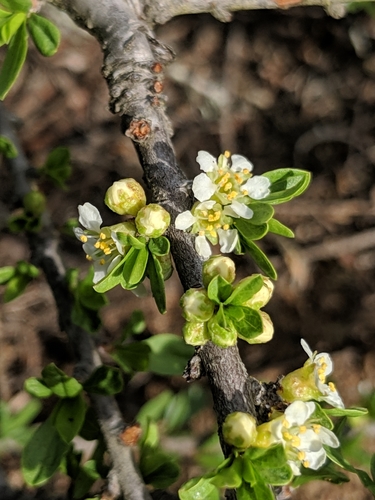
Prunus fasciculata (Torr.) A.Gray is a perennial deciduous shrub that usually grows 2 metres (6+1⁄2 feet) tall, and can exceptionally reach 3 metres (10 ft). It produces many horizontal divaricate branches that are generally spinescent, and it often grows in thickets. Its bark is gray and glabrous. Its leaves measure 5–20 millimetres (1⁄4–3⁄4 inch) long, are narrow linear, shaped like spatulate or oblanceolate with a broad flattened tip that tapers to a narrow base. Leaves grow on very short petioles arranged in fascicles that look like bundles of needles. Its sepals are hairless and lack lobes or teeth. The small white flowers have 3-mm petals, grow solitary or in fascicles, are subsessile, and emerge from leaf axils. This species is dioecious: male flowers produce 10–15 stamens, while female flowers have one or more pistils. The plant produces numerous fragrant flowers from March to May, which attract bees that act as its pollinators. Its drupe is roughly 1 centimetre (1⁄2 in) long, ovoid, light brown, pubescent, and has thin flesh. This species is native to the deserts of Arizona, California, Baja California, Nevada, and Utah. It favors sandy or rocky soil on dry slopes and washes, and usually grows at elevations below 7,000 feet (2,100 m). This plant is not cultivated. Some Native American groups within its native range have traditional uses for it: the Cahuilla prepared the drupe as a delicacy, and wild almonds from this plant were considered a delicacy by Native Americans. The Kawaiisu used the plant's tough twigs as fire-starting drills and for the front portion of arrow shafts. The seeds contain too much cyanide to be eaten raw, though archaeological evidence shows that ancient Mojave Desert populations pounded the seeds into flour and leached out toxins to make them edible.