About Prunus cerasus L.
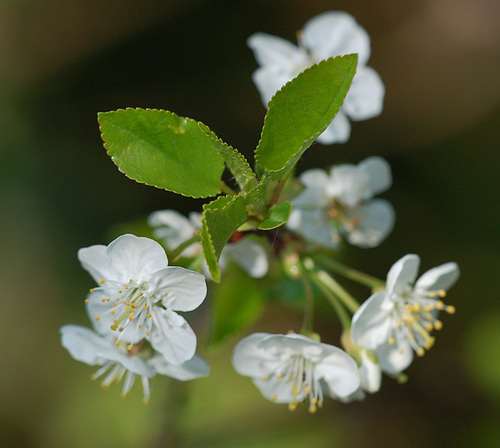
Prunus cerasus L., commonly known as sour cherry, is a tree smaller than the sweet cherry (Prunus avium), reaching a height of 4–10 m. It has twiggy branches, and its crimson to near-black cherries grow on shorter stalks. It is closely related to sweet cherry, but its fruit is more acidic. The fruit of this species persists for an average of 17.4 days, and every fruit contains exactly one seed. Fruits average 84.9% water by content; their dry weight is made up of 39.7% carbohydrates and 1.0% lipids.
Prunus cerasus L. is distributed across much of Europe, North Africa, and West Asia. There are likely no truly wild populations of the species. However, the subspecies acida easily escapes cultivation and is naturalized throughout the species' growing range.
Cultivated sour cherries were selected from wild specimens of Prunus cerasus from regions around the Caspian and Black Seas, and were known to Greek societies by 300 BC. They were also used by Persians and Romans; Romans introduced sour cherries to Britain long before the 1st century AD. As early as the 12th century, a Morello-type sour cherry was grown in the Schaerbeek region of Belgium. The Schaerbeek cherry population was devastated by the Napoleonic Wars and World Wars. Today, there are active efforts to reestablish Schaerbeek sour cherries, which are a defining component of the Kriek lambic beer culture of Belgium. This beer culture was recognized by UNESCO in 2016 as an Intangible Cultural Heritage of Humanity. Though classified as a Morello type, Schaerbeek cherries are distinct: they are ovate along the horizontal axis, develop a deeper burgundy color when ripe, have a lower chill requirement to set fruit, and have a characteristic cinnamon aroma and flavor.
In England, sour cherry cultivation was popularized in the 16th century during the reign of Henry VIII. Sour cherries became a common crop among growers in Kent, and by 1640, more than two dozen named cultivars were recorded. Before the Second World War, more than fifty sour cherry cultivars were in cultivation in England; today, few are grown commercially. While named cultivars such as 'Kentish Red', 'Amarelles', 'Griottes', and 'Flemish' are still maintained, most nurseries only sell the generic Morello cultivar.
Morello is a late-flowering variety, so it is more likely to avoid spring frosts than sweet cherries, making it a more reliable cropper. Morello cherries ripen from mid to late summer, reaching maturity toward the end of August in southern England. Morello is self-fertile, and would make a good pollenizer for other cherry varieties if it did not flower so late in the growing season.
Sour cherries require similar cultivation conditions to pears: they grow best in rich, well-drained, moist soil, and need more nitrogen and water than sweet cherries. Trees grow poorly if waterlogged, but they tolerate poor drainage better than sweet cherry varieties. Like sweet cherries, Morellos have traditionally been cultivated by budding onto strong-growing rootstocks, which produce trees too large for most home gardens, though newer dwarfing rootstocks such as Colt and Gisella are now available.
In spring, flowers should be protected; trees should be weeded, mulched, and sprayed with natural seaweed solution. Spring is also the appropriate time to complete any required pruning, as cherries should not be pruned during the dormant winter months. Morello cherry trees produce fruit on younger wood than sweet cherry varieties, so they can tolerate heavier pruning. They are most often grown as standard trees, but can also be fan-trained (and crop well even on cold walls), or grown as low bushes.
Sour cherries are affected by fewer pests and diseases than sweet cherries, but they often experience heavy fruit loss from birds. In summer, developing fruit should be protected with netting. When harvesting, fruit should be cut from the tree rather than pulled by the stalk, to avoid damaging the tree or fruit.
Unlike most sweet cherry varieties, sour cherries are self-fertile or self-pollenizing. Two consequences of this are that seeds generally grow into plants that match the parent cultivar, and that much smaller pollinator populations are required, because pollen only needs to be moved within individual flowers. In areas where pollinators are scarce, orchard growers find that adding stocked beehives improves crop yields.