About Prunus caroliniana (Mill.) Aiton
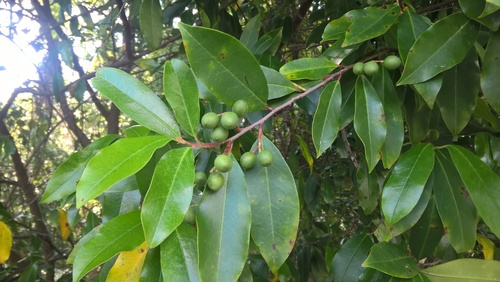
Prunus caroliniana (Mill.) Aiton is a small to medium-sized evergreen tree that reaches approximately 5–13 meters (16–43 feet) in height, with a canopy spread of about 6–9 meters (20–30 feet). Its leaves are dark green, alternate, shiny, leathery, and elliptic to oblanceolate in shape, measuring 5–12 centimeters (2–4+1⁄2 inches) long. Leaves typically have a smooth, entire margin, though they may occasionally have subtle serrations (called serrulate margins), and all have cuneate bases. Reproductively mature trees always have leaves with entire margins, while leaves on immature trees often have subtle serrations. Twigs are slender, glabrous, and range in color from red to grayish brown. When crushed, leaves and green twigs release a scent described as similar to maraschino cherries or almond extract. The tree produces fragrant white to cream-colored flowers arranged in 5–8 cm (2–3 in) long racemes (stalked clusters of blooms), from late winter to early spring. Its fruits are tiny black cherries, about 1 cm (1⁄2 in) in diameter, that persist through the winter and are eaten primarily by birds between February and April. Ecologically, this tree acts as a host plant for the coral hairstreak, eastern tiger swallowtail, red-spotted purple, spring azures, summer azures, and viceroy butterflies. Adult butterflies feed on nectar from the tree’s spring flowers, while its fruits are eaten by songbirds, wild turkeys, quail, raccoons, foxes, and small mammals. Leaves and branches of Prunus caroliniana contain high levels of cyanogenic glycosides, which break down into hydrogen cyanide when damaged. This makes the tree a potential toxic hazard for grazing livestock and children, and also causes it to be highly resistant to deer browsing. The species has long been grown as an ornamental tree and landscape hedge shrub in gardens across many parts of the Atlantic states of the United States. It is classified as hardy in USDA plant hardiness zones 7B through 10A, and is commonly planted in areas that require a tough, modest-sized broadleaved evergreen tree. It prefers full sun and well-drained, acidic soil, and typically develops chlorosis when grown in overly alkaline soil. It has been recorded growing at elevations up to 152 m (500 ft).