About Prunus campanulata Maxim.
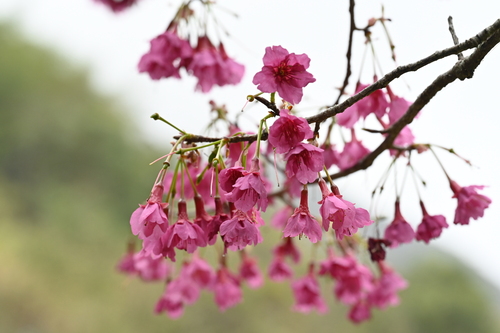
Prunus campanulata Maxim., a species of cherry, was first formally described in 1883 by Carl Johann Maximowicz. This cherry is native to Japan, Taiwan, southern and eastern China (specifically Guangxi, Guangdong, Hainan, Hunan, Fujian, and Zhejiang), and Vietnam. It grows as a large shrub or small tree, reaching a height of 3 to 8 meters, or 10 to 26 feet. In English, it has three common names: Taiwan cherry, Formosan cherry, and bellflower cherry. It is widely cultivated as an ornamental tree, and serves as a symbol of Nago, located in Japan's Ryukyu Islands. It is an early-blooming cherry blossom tree. Its seeds have both physiological and morphological dormancy; this dormancy is broken by exposure to cold and warm temperatures before the seeds can germinate. Its flowers are fertilized by pollinating insects, and plants can start flowering within 1 to 2 years after germination.