About Prunus avium (L.) L.
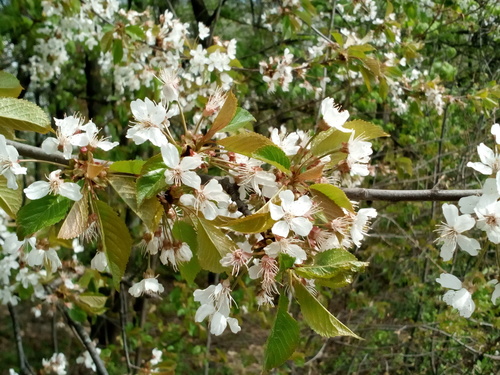
Prunus avium (L.) L. is a deciduous tree that reaches 5–25 metres (16–82 feet) in height, with a trunk that can grow up to 1.5 m (5 ft) in diameter. Young trees have strong apical dominance, producing a straight trunk and a symmetrical conical crown; the crown becomes rounded to irregular on older specimens. Young trees have smooth reddish-brown bark marked by prominent horizontal grey-brown lenticels, while older trees develop thick dark blackish-brown, fissured bark. Its leaves are alternate, simple, and ovoid-acute, measuring 7–14 centimetres (2+3⁄4–5+1⁄2 inches) long and 4–7 cm (1+1⁄2–2+3⁄4 in) broad. The upper leaf surface is glabrous, with a matte or sub-shiny green colour, while the lower surface is variably finely downy. Leaves have a serrated margin, an acuminate tip, and a 2–3.5 cm (3⁄4–1+1⁄2 in) long green or reddish petiole that bears two to five small red glands; each serrated leaf margin tip also bears a small red gland. In autumn, leaves turn orange, pink, or red before falling. Flowers emerge in early spring at the same time as new leaves, arranged in corymbs of two to six flowers. Each flower hangs from a 2–5 cm (3⁄4–2 in) peduncle, is 2.5–3.5 cm (1–1+1⁄2 in) in diameter, and has five pure white petals, yellowish stamens, and a superior ovary. Flowers are hermaphroditic and pollinated by bees. The ovary contains two ovules, only one of which develops into a seed. The fruit is a drupe 1–2.5 cm (1⁄2–1 in) in diameter (larger in some cultivated varieties), which becomes bright red to dark purple when it ripens in midsummer. Fresh fruit varies in taste from sweet to somewhat astringent and bitter. Each fruit holds a single hard-shelled stone 8–12 millimetres (3⁄8–1⁄2 in) long, 7–10 mm wide and 6–8 mm thick, with a groove along its flattest edge; the seed (kernel) inside the stone is 6–8 mm long. Fruits persist for an average of 3 days, are on average 81.8% water, and their dry weight contains 45.1% carbohydrates and 1.8% lipids. Prunus avium has a diploid chromosome set of sixteen chromosomes (2n = 16). Prunus avium is native to Europe, Anatolia, Maghreb, and Western Asia. Its native range extends from the British Isles south to Morocco and Tunisia, north to the Trondheimsfjord region in Norway, and east to the Caucasus and northern Iran, with a small isolated population in the western Himalaya. The species is widely cultivated in other regions, and has become naturalized in North America, New Zealand, and Australia. Multiple types of birds and mammals readily eat its fruit, digesting the fruit flesh and dispersing the seeds via their droppings. Some rodents and a small number of bird species, most notably the hawfinch, also crack open the stones to eat the inner kernel. Its leaves serve as food for some animals, including Lepidoptera such as the case-bearer moth Coleophora anatipennella. The tree exudes gum from bark wounds to seal the opening and block entry of insects and fungal infections. Prunus avium is thought to be one of the parent species of Prunus cerasus (sour cherry), resulting from ancient crosses between it and Prunus fruticosa (dwarf cherry) in regions where the two parent species overlap. All three species can interbreed with one another. Prunus cerasus is now a distinct stable species that developed beyond its hybrid origin. All parts of this plant except the ripe fruit are slightly toxic, as they contain cyanogenic glycosides. Prunus avium is often cultivated as a flowering tree. Due to its large size, it is most often planted in parkland, and used less often as a street or garden tree. The double-flowered cultivar 'Plena' is far more commonly grown than wild single-flowered forms. In the UK, P. avium 'Plena' has received the Royal Horticultural Society's Award of Garden Merit. Two interspecific hybrids, P. × schmittii (P. avium × P. canescens) and P. × fontenesiana (P. avium × P. mahaleb) are also grown as ornamental trees. The aromatic gum from bark wounds can be chewed as a substitute for chewing gum. Astringent, antitussive, and diuretic medicine can be prepared from the stalks (peduncles) of the drupes. A green dye can also be made from the plant. In Europe, wild cherry is used extensively for afforestation of agricultural land, and is valued for wildlife and amenity plantings. Multiple European countries run gene conservation and/or breeding programmes for wild cherry. Dihydrowogonin has been identified as a major constituent in the methanol extract of wild cherry bark.