About Prunus amygdalus Batsch
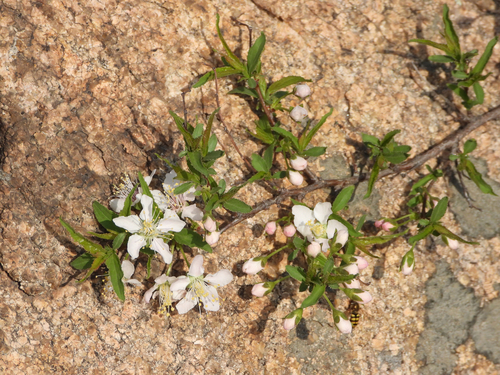
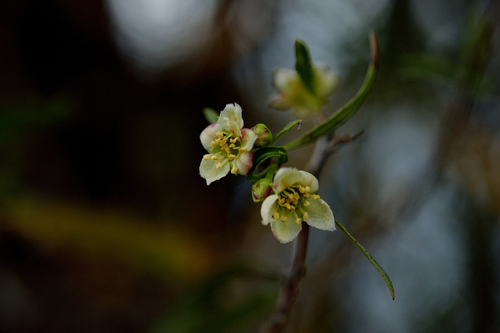
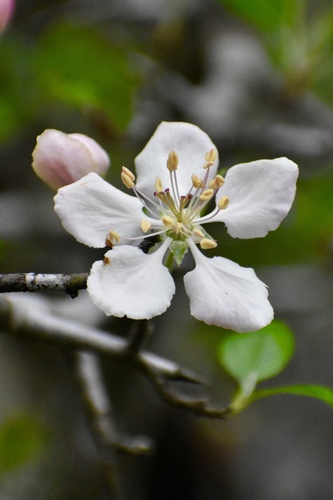
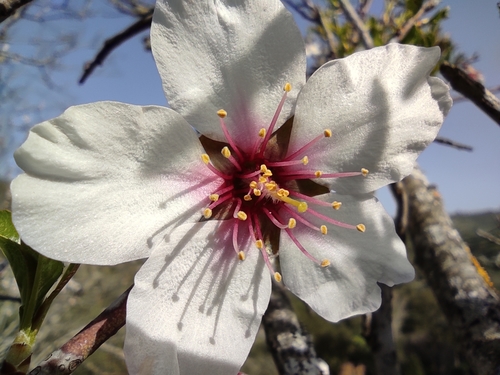
Prunus amygdalus Batsch, the almond, is a deciduous tree that reaches 3–4.5 metres (10–15 feet) in height, with a trunk that can grow up to 30 centimetres (12 inches) in diameter. Young twigs are green when new, turn purplish in areas exposed to sunlight, and become grey in their second growing year. Its leaves are 8–13 cm (3–5 in) long, with serrated margins and a 2.5 cm (1 in) petiole. Almonds produce fragrant white to pale pink flowers, each 3–5 cm (1–2 in) in diameter with five petals. Flowers grow singly or in pairs, and emerge before leaves in early spring. Almond trees grow best in Mediterranean climates with warm, dry summers and mild, wet winters. The optimal temperature range for their growth is 15 to 30 °C (59 to 86 °F), and tree buds require 200 to 700 hours of temperatures below 7.2 °C (45.0 °F) to break winter dormancy. Almond trees begin producing an economically harvestable crop three years after planting, and reach full production five to six years after planting. The fruit matures in autumn, 7–8 months after flowering. The almond fruit measures 3.5–6 cm (1+3⁄8–2+3⁄8 in) long, and it is a drupe, not a true botanical nut. Unlike related Prunus species such as plums and cherries that have a fleshy outer mesocarp, the almond fruit has a thick, leathery, grey-green, downy outer coat called a hull, made up of the outer exocarp (skin) and mesocarp. Inside the hull is a woody endocarp that forms a reticulated, hard shell, similar to the outer layer of a peach pit, called the pyrena. Inside the shell is the edible seed, which is commonly referred to as an almond nut. Most fruits contain one seed, but occasionally two develop. After the fruit matures, the hull splits and separates from the shell, and an abscission layer forms between the fruit and its stem to allow the fruit to fall from the tree. During commercial harvest, mechanized tree shakers are used to speed up fruit drop to the ground for collection. The precise origin of the almond is controversial, with different sources placing its emergence across a wide range of geographic regions. Some sources state its origin spans an area covering Central Asia, Iran, Turkmenistan, Tajikistan, Kurdistan, Afghanistan, and Iraq, or an eastern Asian subregion between Mongolia and Uzbekistan. Other assessments, drawing on both botanical and archaeological evidence, note almonds originated and were first cultivated in West Asia, particularly in the countries of the Levant. Most recent sources name Iran and Anatolia (modern-day Turkey) as the origin locations of the almond, with Iran as its main center of origin. The wild progenitor of domesticated almond also grew in parts of the Levant. Humans spread almond cultivation centuries ago along the shores of the Mediterranean Sea into northern Africa and southern Europe, and more recently to other regions of the world, most notably California. The selection of sweet almond types from the many bitter types growing in the wild marked the start of almond domestication. The wild ancestor of the domesticated almond is still unknown, but the species Prunus fenzliana is considered the most likely wild ancestor, in part because it is native to Armenia and western Azerbaijan, where almond domestication likely occurred. Early farmers grew wild almond species, first unintentionally in garbage heaps, and later intentionally in their orchards. Most widely planted almond varieties are self-incompatible, which means they require pollen from an almond tree with different genetic characteristics to produce seeds. For this reason, almond orchards must be planted with a mixture of different almond varieties. Pollen is transferred between flowers by insects, so commercial almond growers must ensure enough pollinating insects are present to support seed production. Large-scale almond production in the United States creates a major challenge to secure enough pollinating insects, so additional pollinating insects are brought to almond orchards. The pollination of California's almonds is the largest annual managed pollination event in the world, with over 1 million beehives — nearly half of all beehives in the United States — brought to almond orchards each February. Much of the bee supply for this event is managed by pollination brokers, who contract with migratory beekeepers from at least 49 U.S. states. This pollination industry was heavily impacted by colony collapse disorder at the turn of the 21st century, which caused a nationwide shortage of honey bees and increased the price of insect pollination for almond growers. To partially offset these costs for growers, researchers at the United States Department of Agriculture's Agricultural Research Service developed self-pollinating almond trees that combine the self-pollinating trait with desirable commercial qualities including good flavor and high yield. While self-pollinating almond varieties already existed, they lacked key commercial characteristics. Through natural hybridization between different almond varieties, researchers produced a new self-pollinating variety that yields a high quantity of commercial quality nuts. Bitter almonds contain around 40 times more cyanide than the trace levels found in sweet almonds. Extract of bitter almond was once used medicinally, but even small doses can cause severe or lethal effects, especially in children; cyanide must be removed from bitter almond products before consumption. The reported acute oral lethal dose of cyanide for adult humans is 0.5–3.5 mg/kg (0.2–1.6 mg/lb) of body weight, which is approximately equivalent to 50 bitter almonds; consuming just 5–10 bitter almonds can be fatal for children. Symptoms of cyanide poisoning from bitter almond consumption include vertigo and other typical effects of cyanide poisoning. Almond consumption may cause allergy or intolerance. Cross-reactivity is common with peach allergens (lipid transfer proteins) and other tree nut allergens. Symptoms range from local reactions, such as oral allergy syndrome and contact urticaria, to systemic reactions including anaphylaxis, which can cause urticaria, angioedema, and gastrointestinal and respiratory symptoms. Almonds are susceptible to infection by moulds that produce aflatoxin, a potent carcinogenic chemical produced by moulds such as Aspergillus flavus and Aspergillus parasiticus. Mould contamination can come from soil, previously contaminated almonds, and almond pests such as the navel-orange worm. High levels of mould growth typically appear as grey to black filamentous growth, and it is unsafe to eat mould-infected almonds. Many countries enforce strict legal limits for allowable levels of aflatoxin contamination in almonds, and require testing before almonds can be marketed to consumers. For example, the European Union has required all almond shipments entering the EU to be tested for aflatoxin since 2007. If aflatoxin levels do not meet strict safety regulations, the entire consignment must either be reprocessed to remove the aflatoxin or destroyed. Almond breeding programs have identified a trait called high shell-seal, which provides resistance against infection by Aspergillus species, and thus against the development of aflatoxin. Almonds were one of the earliest domesticated fruit trees, because they can be grown reliably from seed, which allowed their cultivation to possibly predate the development of grafting. Domesticated almonds appear in the archaeological record as early as the Early Bronze Age (3000–2000 BCE) at sites such as Numeira in Jordan, and possibly even earlier. Almonds were also found in the tomb of the Egyptian pharaoh Tutankhamun, dated to around 1325 BCE, and were likely imported from the Levant. A 12th-century Book on Agriculture written by Ibn al-'Awwam includes a section on almond tree cultivation in Spain. Among European countries reported to cultivate almonds by the Royal Botanic Garden Edinburgh, Germany is the northernmost, though domesticated almonds can be found growing as far north as Iceland.