About Prunus americana Marshall
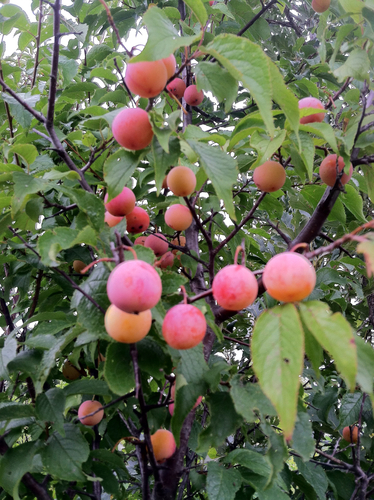
Prunus americana Marshall, commonly known as the American plum, grows as a large shrub or small tree that reaches up to 4.6 metres (15 feet) tall. At maturity, it has a crown with equal width and height of 10 feet. This species is adapted to coarse- and medium-textured soils, and cannot tolerate fine soils made up of silt or clay. It can survive harsh winters with temperatures as low as -40 degrees Fahrenheit, but has very little tolerance for shade, drought, or fire. Its most active growth occurs in spring and summer; it blooms in spring and begins producing fruit in summer. It propagates naturally by seed, and spreads relatively slowly across a stand because plants grown from seed take a long time to reach maturity. American plum has shallow, widely spread roots that produce suckers. Individual plants grow multiple stems that develop scaly bark as they age. The branches are thorny. Leaves are alternately arranged and oval-shaped, usually 5.1–10.2 centimetres (2–4 inches) long. The upper leaf surface is dark green, while the underside is smooth and pale. The small five-petaled white flowers grow singly or in clusters in leaf axils. The fruits are globular and roughly 2.5 cm (1 inch) in diameter. American plum has both ornamental and culinary uses. Its white spring flowers are decorative, and its short single trunk makes it a popular residential landscape tree. According to Sargent, as an ornamental plant P. americana has real value; the long wand-like branches form a wide, graceful head that is handsome in winter, and in spring it becomes covered with masses of pure white flowers, followed by full bright foliage and abundant showy fruit. Over 200 cultivated forms of American plum have been developed for cultivation. Its fruit has a mix of sour and sweet flavor, it can be eaten fresh, or processed into preserves, jellies, jam and wine. On farms, medium to tall American plum shrubs or trees are planted as windbreaks, or for plantings along highways or riversides. Its dense growth effectively lowers wind speed near the ground. The root suckering habit of American plum makes it effective at stabilizing stream banks and gullies, and it can tolerate several days of flooding. Some commercial properties plant these trees along entrance roads. Many birds and wild animals eat the fruit of American plum, and both white-tailed deer and mule deer feed on its twigs and leaves. Historically, American plum was widely used by Native Americans. Eastern Native Americans planted large numbers of these trees, leading to many places being named Crab Orchard. Plains Indians and the Cheyenne ate the plums; the Cheyenne also used the species' branches for the Sun Dance. The Navajo used its roots to create a red dye.