About Prunus africana (Hook.fil.) Kalkman
Prunus africana, commonly called African cherry, is widely distributed across Africa. It grows in montane regions of central and southern Africa, as well as on the islands of Bioko, São-Tomé, Grande Comore, and Madagascar, at elevations between 900 and 3,400 m (3,000 to 10,000 ft) above sea level. It is a canopy tree reaching 30 to 40 m in height, and it is the tallest species in the genus Prunus. Trees with large trunk diameters develop broad, impressive spreading crowns. This species needs a moist climate with 900 to 3,400 mm (35 to 130 in) of annual rainfall, and it tolerates moderate frost. It is classified as a light-demanding secondary-forest species.
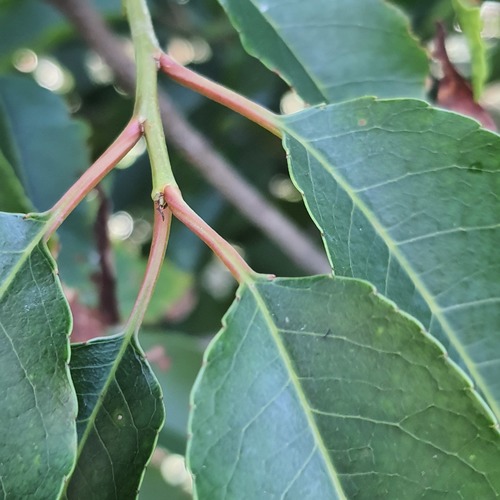
The bark of Prunus africana ranges from black to brown, has a corrugated, fissured, and scaly texture, and forms a characteristic rectangular fissure pattern. Its leaves are alternate and simple, measuring 8 to 20 cm (3.1 to 7.9 in) long. They are elliptical with blunt or sharp pointed tips, hairless, dark green on the upper surface and pale green on the lower surface, with mildly serrated margins. The central leaf vein is depressed on the leaf's upper side and prominent on the underside, and the 2 cm (0.8 in) long leaf stalk (petiole) is pink or red. Its flowers are bisexual, with 10 to 20 stamens, and are pollinated by insects. The flowers are greenish white or buff, arranged in 70 mm (2.8 in) long axillary racemes, and the whole inflorescence measures 3 to 8 cm (1 to 3 in). Flowering occurs from October through May. The fruit is a drupe that ranges from red to brown, measures 7 to 13 mm (0.3 to 0.5 in), and is wider than it is long. It has two lobes, each holding one seed, and grows in clusters. Fruits ripen from September through November, several months after pollination.
Like other members of the genus Prunus, Prunus africana has extrafloral nectaries. These nectaries provide nutrients to insects that defend the tree against herbivores, in exchange for this foliage protection. Beyond its commercial uses, P. africana is an important food source for frugivorous birds and mammals. Dian Fossey noted that fruits of this tree (then called Pygeum africanum) are highly favored by mountain gorillas, which forage on the northwestern slopes of Mount Visoke where extensive ridges of the tree grow. According to East African Mammals, stands of this tree (also referred to there as Pygeum) are habitat for the rare Carruther's mountain squirrel. The publication also notes that this forest type typically has a broken canopy, with many trees covered in climbing plants and dense tangles of undergrowth.
This species has been protected under Appendix II of CITES since 16 February 1995, and it is protected in South Africa under the 1998 National Forests Act (Act 84). Large numbers of P. africana trees are harvested for their bark to meet international demand for its medicinal properties. Early studies of the impacts of bark harvesting found that harvest alters the species' population structure, increases tree mortality, and reduces reproductive output. However, quantitative research into specific life history impacts and potential sustainable harvesting practices only began recently, with work published by 2009. These later studies found that high mortality among reproductive trees (especially the largest individuals, greatly reduced fruit production, and poor seedling survival combine to suggest a poor outlook for future regeneration and long-term survival of harvested P. africana populations.
Prunus africana has a long history of traditional medicinal use. Its bark is used in multiple preparations: as a wound dressing, a purgative, an appetite stimulant, and a treatment for fevers, malaria, arrow poisoning, stomach pain, kidney disease, gonorrhoea, and insanity. An extract called pygeum, made from P. africana bark, is sold as an alternative medicine remedy for benign prostatic hyperplasia (BPH). A 2016 literature review of pygeum found it offered no benefit for BPH, while a 2019 review found limited evidence that it can reduce BPH symptoms.
The hardwood timber of Prunus africana is used to make axe and hoe handles, utensils, wagons, floors, chopping blocks, carving boards, bridge decks, and furniture. The wood is tough, heavy, straight-grained, and pink when newly cut, with a pungent bitter-almond scent. It fades to mahogany brown and becomes odourless as it ages.