About Protostropharia semiglobata (Batsch) Redhead, Moncalvo & Vilgalys
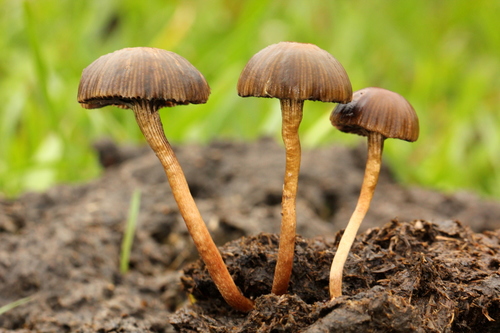
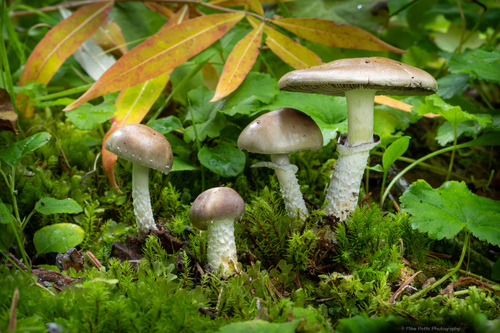
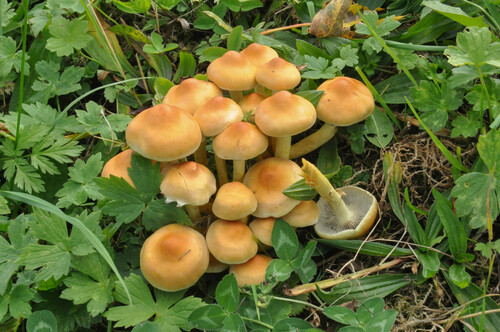
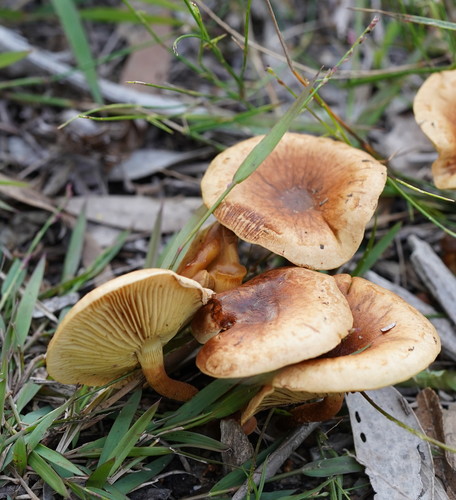
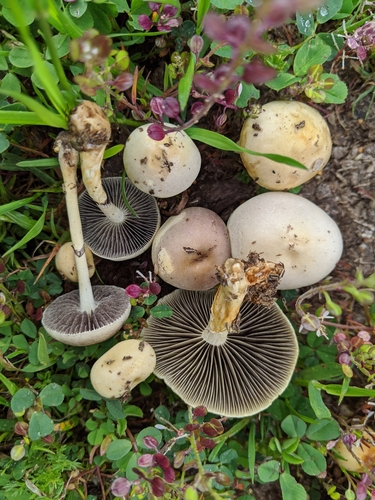
Protostropharia semiglobata has an obtuse to hemispherical cap that grows 1–4.5 cm (0.4–1.8 in) in diameter. The cap surface is smooth, sticky, and light yellow when young, fading to dull yellow or whitish as it matures. The gills usually attach adnately to the stem with a small decurrent tooth. They start grayish, changing to purplish brown to black as they age, with white, fringed edges. Gills are broadly spaced at 6–8 mm apart, and mature gills become ventricose, or swollen. The stem is 3–12 cm (1.2–4.7 in) long, 0.2–0.5 cm (0.1–0.2 in) thick, and has a bulbous base. It is initially filled with cottony pith, and becomes hollow when mature. A delicate ring creates an annular zone on the stem's mid to upper section, which may darken from spore deposits. Above this annular zone, the stem is covered in fine silk-like hairs; below the zone, the stem is sticky. Stem tissue is white with a yellowish pith. The mushroom's flesh has no distinct odor, and a taste ranging from mild to slightly bitter. This species produces a dark purple spore print. Its thick-walled spores are ellipsoidal and smooth, with a small apical germ pore, and measure 16.1–19.0 by 8.8–11.0 μm. The spore-bearing basidia are four-spored, club-shaped, hyaline (translucent), and measure 33–40 by 13–14.6 μm. This is a saprobic species that produces fruiting bodies in small groups on dung, manure-containing soil, lawns, grasslands, or livestock corrals. It has been recorded growing on dung from a variety of wild and domesticated herbivores and ungulates, including rabbit, sheep, cow, buffalo, moose, bear, and wallaby. Sometimes the dung substrate grows under moss, making it appear the mushroom is growing directly from moss. Fruiting bodies sometimes grow alongside another dung-loving fungus, Deconica coprophila. This widespread, common species has a cosmopolitan distribution, and has been recorded from northern Asia, Australia, Europe, Central America, South America, North America, North Africa, and New Zealand. It is thought to have been introduced to Australia with imported domestic livestock.