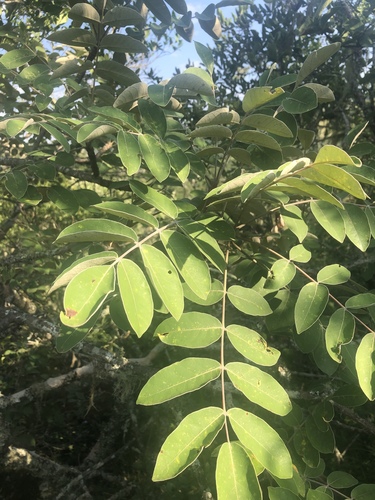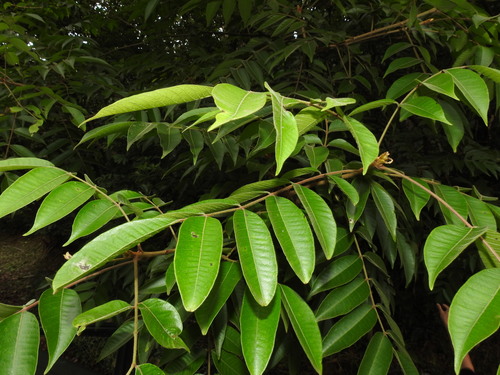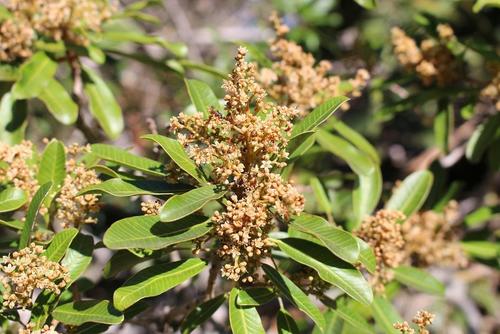
About Protorhus longifolia (Bernh.) Engl.
Protorhus longifolia, commonly known as red beech, is a medium to large, mostly dioecious tree species in the family Anacardiaceae. It is native to South Africa and Eswatini, growing in well-watered habitats from coastal elevation up to 1,250 m. These evergreen trees have dense foliage, rounded crowns, and usually reach 6 to 10 m in height, growing regularly taller when found in forests. In South Africa, its range extends from the Eastern Cape to Limpopo. In Eswatini, it occurs in the western uplands and the Lebombo regions. It can be found growing in coastal, scarp and mistbelt forests, on rock outcrops and escarpments, along riparian fringes, and in woodland. Various forest mammals and birds feed on its fruit, both while the fruit remains on the tree and after it has dropped. Black rhino browse the tree’s bark and foliage. The tree’s fine-grained wood has been used for furniture, planks and fence posts, though it is not considered very durable. Ground bark of this tree, while somewhat poisonous, is used as red muti (Zulu: uMuthi-embomvu). Its sticky milky sap has been used as a glue, for example to secure assegai blades to their handles, and also as a depilatory. This species can be cultivated from fresh seed and grows well in gardens. It works well as a specimen tree or screening plant, and grows relatively quickly, reaching up to 80 cm of growth per year. While it thrives in warm, moist regions, it is also tolerant of drought and slight frost.