About Protopolybia exigua (de Saussure, 1906)
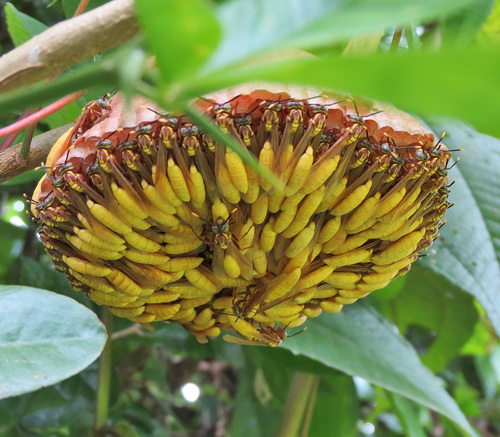
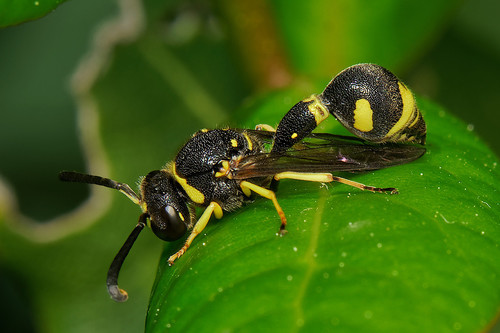
Protopolybia exigua (de Saussure, 1906) is a species of small, swarm-founding wasps. The age of individual wasps can be determined by assessing how dark the cuticle on the apical edge of the fifth gastral sternite is: older wasps in a colony typically have darker cuticle than younger nestmates. The average front wing length of this species is 4.15 mm, and their wings are more rounded in shape than wings of other wasp species. This rounded wing shape may improve the species' flying ability and increase individual fitness. Flight power in P. exigua is directly provided by muscle mass in the mesosoma: larger muscle mass produces stronger flight output. Due to increased wing drag, P. exigua do not flap their wings; instead, they row their wings for flight. Mature P. exigua eggs have a full chorion, a blue tint, and a shiny outer coat. Immature oocytes that reach the same size as mature eggs can be told apart by their cream color and less glossy appearance. This wasp species ranges geographically from Bolivia to southern Brazil, and has been specifically recorded in Venezuela, Guatemala, and Colombia. P. exigua can live in orange orchards and eucalyptus plantations. They typically occupy green areas surrounded by small trees and bushes. Unlike the mud nests of Polybia emaciata and Parachartergus colobopterus, which are strongly attached to stable foundations, P. exigua nests are much more frequently destroyed. These nests most often hang from the underside of plant leaves and tree branches. Nests rarely survive longer than 6 months, because they are attached to leaves that eventually fall, and nests are also consistently at risk of parasitoid infestation. Parasitoid-caused nest damage can separate the wasps' colony cycle from their nesting cycle, and ultimately break apart the colony.