About Protonotaria citrea (Boddaert, 1783)
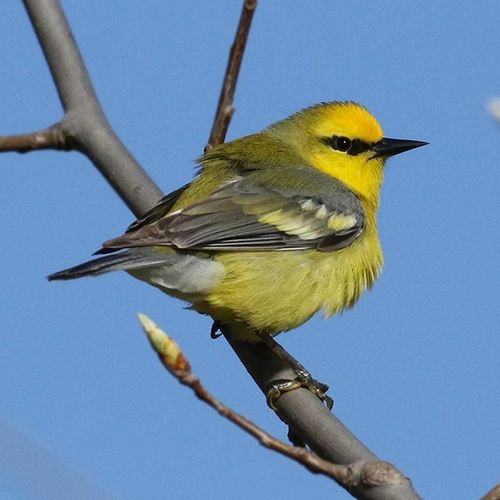
The prothonotary warbler, Protonotaria citrea (Boddaert, 1783), measures 13 cm (5.1 in) long, has an average weight of 14.3 g (0.50 oz), and a wingspan of 22 cm (8.75 in). It has an olive-coloured back, blue-grey wings and tail, yellow underparts, a relatively long pointed bill, and black legs. Adult males have a bright orange-yellow head, while females and immature birds are duller and have a yellow head. When seen in flight from below, the short, wide tail has a distinctive two-toned pattern: white at the base and dark at the tip. Most prothonotary warblers breed in hardwood swamps located in extreme southeastern Ontario and the eastern United States. They may also nest near other bodies of water, including creeks, streams, ponds, and swimming pools. Their habitat during migration is not well understood, but they are especially common in Belize during spring migration. They spend the winter in the West Indies, Central America, and northern South America, primarily in mangrove swamps. This species is a rare vagrant in parts of the western United States, most notably California. Prothonotary warblers are the only eastern warbler that nests in natural or artificial cavities, and they sometimes use old downy woodpecker holes. Males often build multiple incomplete, unused nests within their territory; females build the final breeding nest and lay between 3 and 7 eggs. Their preferred foraging habitat is dense, woody streams, where they forage actively in low foliage, feeding mainly on insects and snails. The song of this bird is a simple, loud, repeating series: sweet-sweet-sweet-sweet-sweet. Its call is a loud, dry chip, similar to the call of a hooded warbler, and its flight call is a loud seeep.