About Proterebia afra (Fabricius, 1787)
Scientific name: Proterebia afra (Fabricius, 1787)
Description adapted from Seitz: The nominal form (previously referenced as E. afer Esp., afra Bsd., phegea Bkh) (37 h) has dark black-brown upper hindwings. The apex, and usually also the upper section of the distal margin, is dusted with grey. The forewing holds 6 to 7 black ocelli with white centers, set within reddish yellow rings. One small ocellus sits near the wing apex, followed by two larger, more proximal ocelli that are contiguous and sometimes even merged together. The remaining 3 to 4 ocelli stand before the distal margin and are only slightly smaller than the two proximal large ones.
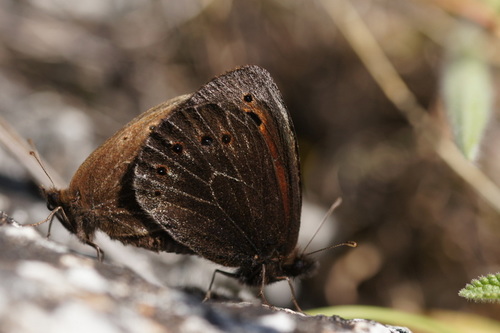
The underside of the forewing is sombre brown, with a red-brown cell, and the wing apex is more or less dusted with grey. The ocelli match the pattern seen on the upper side, but the two positioned near the hindmargin are nearly always absent. The underside of the hindwing is black-brown, with whitish grey veins and an obsolete band of the same whitish grey colour. There are usually 7 ocelli on the underside hindwing, which are smaller than those on the upper surface, and are not bordered with reddish yellow, but rather with white-grey. The abdomen is black on its upper side and grey on its underside. This nominal form ranges from South Russia and Anterior Asia to East Siberia.
The form dalmata God. (37 h) is somewhat larger than the nominal form. Its apex and distal margin have a sparser dusting of white-grey. On the underside of the hindwing, the veins are dark, rather than shaded with white-grey as they are in the nominal afer form. This form is found in Dalmatia and Western Kurdistan.
The form hyrcana Stgr. (= afra Christ.) (37 h) has dense white-grey dusting across a broad area of the apex and distal margin. All ocelli on both wing surfaces are visibly larger than in the nominal form, and are bordered with light yellow rings. This form occurs in Persia.
Adult butterflies are on the wing in spring, often as early as April. They inhabit rocky precipices and boulder-covered slopes, and settle on stones. They do not appear to be common in many of their flight locations.