About Protea welwitschii Engl.
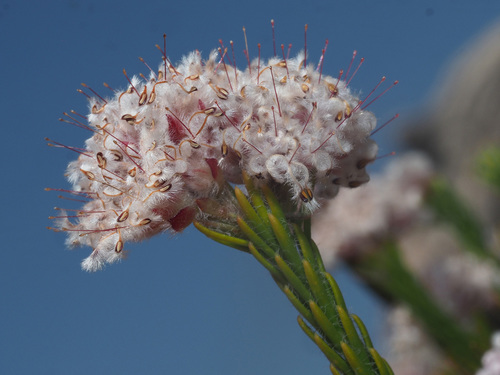
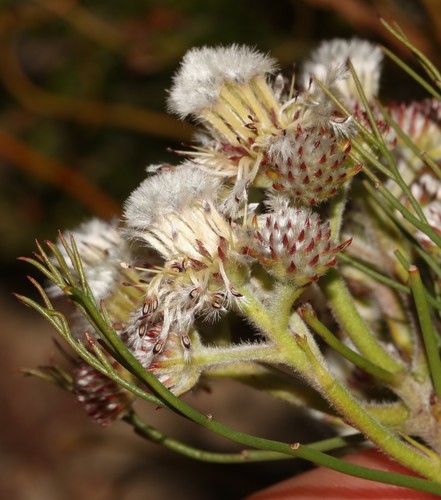
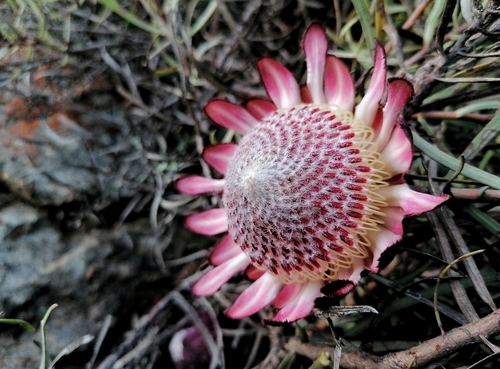
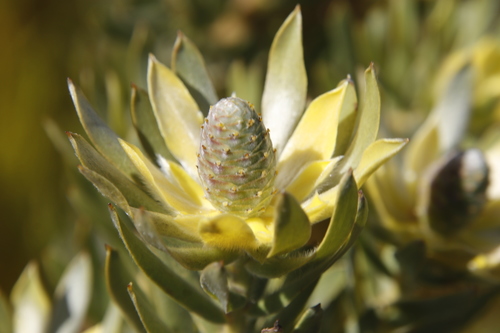
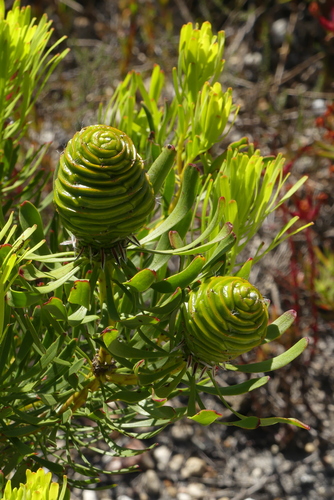
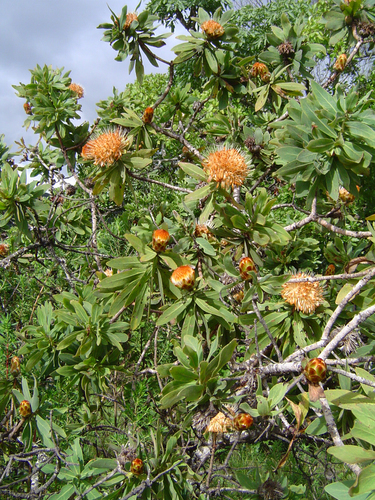
Protea welwitschii Engl. typically grows as a spreading, multi-stemmed shrub, or a small, gnarled, bushy tree. In tropical East Africa and Zambia, it reaches 1–3 metres (3.3–9.8 ft) in height, and may exceptionally grow to 5 metres (16 ft). In the 1850s, Friedrich Welwitsch recorded individuals growing to 3.7–6.1 m (12–20 feet) on the Huíla Plateau in Angola. Plants growing in dambos in Zambia can develop an unusual suffrutex growth form, producing multiple 1 metre (3.3 ft) tall, erect, unbranched annual or short-lived stems from ground level. In its shrub form, branches grow from an underground bole or root-stock. The trunk can reach 30 centimetres (12 in) in diameter at the base. It is gnarled, and covered in irregularly fissured, brown-black bark. Young stems are covered in a brown, tomentose fuzz. The leaves are elliptic to oblanceolate in shape, bluish-green in colour, and grow up to 12 cm long and 9.5 cm wide. Young leaves are densely covered in velvety white or brown hairs; they usually become hairless when mature, retaining hair only at the leaf base. The flower heads grow terminally at the ends of branches, and are typically grouped in clusters of two, three, or four, reaching up to 6 cm in diameter. According to different sources, the bracts surrounding the inflorescence range from white to pale cream, or from pale yellowish to brown, and are covered in silky hairs. Pink bracts also occur, though uncommonly. The inner bracts are oblong, measuring 5 cm long by 1.5 cm wide. The true individual flowers are densely hairy, creamy-white in colour, and turn rusty brown as they age. The species is monoecious, with both male and female reproductive parts present in each flower. The fruit is a densely hairy nut. Unlike some other Protea species, P. welwitschii does not store seeds in its inflorescences for multiple years; seeds are released nine to twelve months after flowering, dispersed by wind, and then lie on the ground until conditions are favourable for germination. This species is widely distributed across the southeastern third of Africa south of the Sahara, and does not grow in the Sahel region of West Africa. Confirmed countries where it occurs include Rwanda, Burundi, Uganda, Tanzania, the Democratic Republic of Congo, Zambia, Angola, Zimbabwe, Malawi, Mozambique, Lesotho, and South Africa. In Zambia, it has been recorded in Western, Copperbelt, Central, Luapula, Northern, Muchinga, and Lusaka provinces. During eight years of botanical collecting in Angola, Welwitsch only found this species on the Huíla Plateau. In Mozambique, it occurs in Manica, Niassa, Sofala, and Zambezia provinces. On the slopes below Mount Dombe in the Chimanimani Mountains, it is common in steep grasslands located just above the miombo treeline. In South Africa, it grows in the highlands of the country’s eastern and northeastern regions, and has been recorded in Gauteng, KwaZulu-Natal, Limpopo, Mpumalanga, and North West Province. It grows in a variety of habitats, including bushveld, thornveld, sourveld, wooded slopes, rocky hillsides, miombo woodland, and ericaceous fynbos. In East Africa, it is usually found in montane grassland at altitudes between 1,800 and 2,900 metres. In central and southeastern tropical Africa, it may also grow in other grassland types, including low-altitude dambos and other wet grassy areas up to 1,220 metres in altitude, and occasionally occurs in wooded grassland, rocky grassland, or open grassland at 1,500 to 2,400 metres. In South Africa, it has been recorded at altitudes from 300 to 2,000 metres; while it primarily grows in various types of mountainous bushveld and grassland, it can also be found in grassland near the coast in some eastern areas. In Mozambique, it has been recorded at altitudes between 1,390 and 1,500 metres. It is often found in rocky areas and can grow on steep slopes. In Mozambique, it has been found growing in soils derived from quartzite sandstone. In South Africa, it has been recorded growing in soils derived from dolomite, sandstone, shale, or andesite, as well as in sandy soils. In parts of Zambia, it can tolerate soil concentrations of copper and nickel that are toxic to most other trees and shrubs. It blooms from summer to autumn. In Southern Africa, flowering occurs from December to May, with a peak bloom from February to March in Zambia, and a main peak from January to February in South Africa. It is pollinated by beetles and birds. Adult plants can survive the periodic wildfires that sweep through their habitat by re-sprouting from their underground bole.