About Protea repens (L.) L.
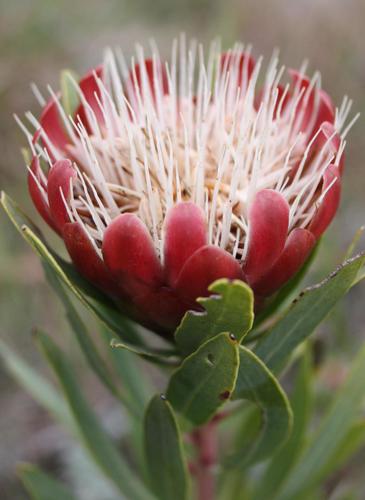
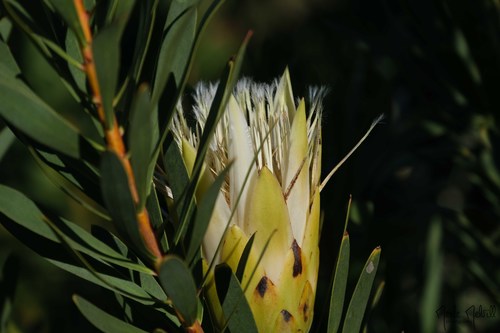
Protea repens is a dense shrub that reaches 1 to 4 metres (3 feet 3 inches to 13 feet 1 inch) in height. Its inflorescences, which range in color from deep red to creamy white, grow at the ends of branches, often tucked between two growing branchlets. This species grows widely across fynbos habitats on a variety of different soils. Like many other Protea species, P. repens is adapted to an environment where bushfires are required for reproduction and regeneration. Most Protea species fall into one of two broad groups based on their response to fire: reseeders are killed by fire, but fire triggers the release of their canopy-stored seed bank, encouraging recruitment of the next generation; resprouters survive fire and resprout from a lignotuber, or more rarely from epicormic buds protected by thick bark. P. repens is a reseeder, and its life cycle depends on its seeds, which may be stored underground by ants or remain on old flowerheads. The large, showy inflorescences of this species are pollinated by both nectarivorous birds and insects, including the Cape Honeybee. Because P. repens produces a large volume of nectar, people have historically boiled this nectar down to make a syrup called bossiestroop. This species is hardy to UK zone 9 and is sensitive to frost.