About Protea recondita H.Buek ex Meisn.
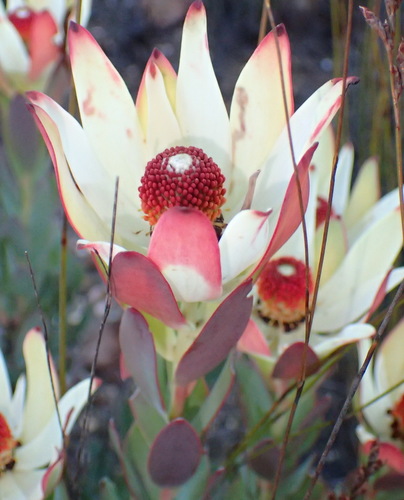
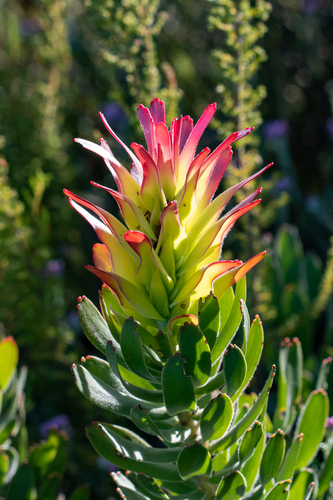
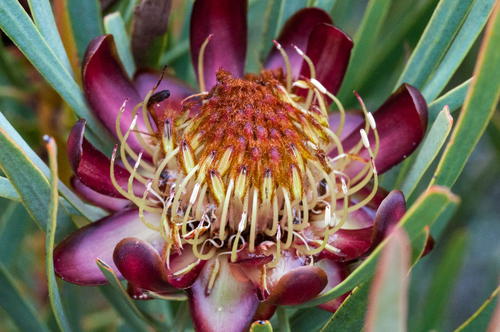
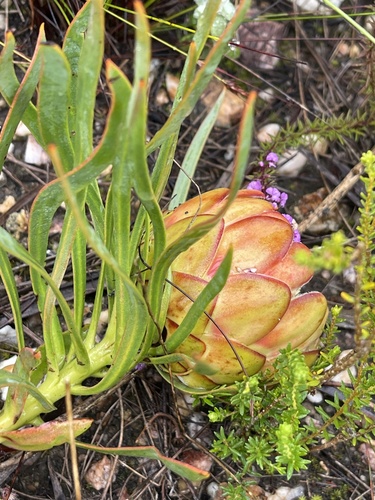
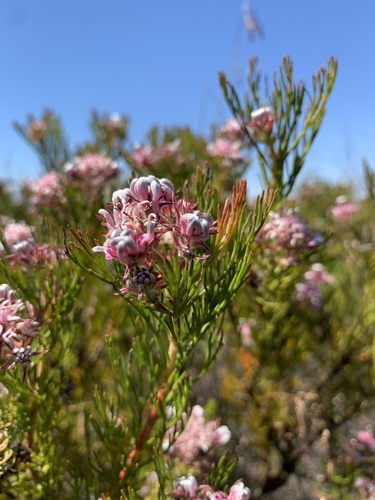
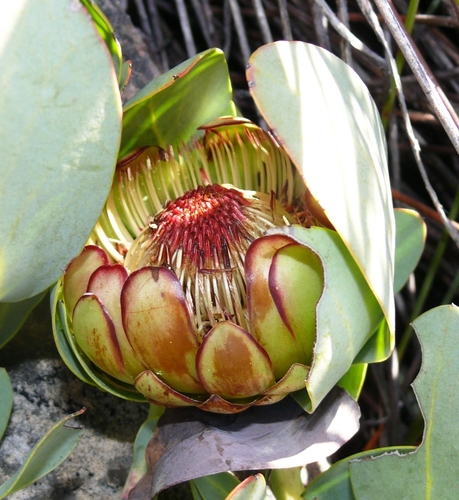
Protea recondita, commonly called the hidden sugarbush, is a flowering plant in the genus Protea of the family Proteaceae. It is endemic to the Cape Region of South Africa, distributed from the Piketberg and Cederberg to the Groot Winterhoek mountains. In Afrikaans, it is known as gesigtoehouprotea or skaamroos. Its flowers are pollinated by non-flying mammals: rodents and elephant shrews. This species is endemic to the Western Cape province of South Africa. Its range extends from Piketberg and Cederberg in the north, south to Groot Winterhoek, and reportedly further south to the Koue Bokkeveld Mountains. It is known to occur at more than ten localities. While its total extent of occurrence is 4,008 km², its actual area of occupancy is only 272 km². The Piketberg is an inselberg, and a single tiny population grows atop it, which contained only two individual plants as of 2004. This species grows mostly on rocky slopes near mountain summits, at altitudes between 1,000 and 2,000 metres, or 800 and 1,800 metres. It only grows in montane fynbos on sandstone-derived soils. In the northern part of its range, the plants are rare and scattered, especially in rocky habitats. In the Groot Winterhoek mountains in the southern part of its range, it grows in open habitat, where it can form isolated, but locally dominant, dense clumps. It was first collected at Ezelsbank, growing alongside the fynbos shrubs Elytropappus spinellosus, Oedera sedifolia, Passerina rigida (identification is uncertain), Phylica capitata, Pteronia fasciculata, Rafnia ovata, and Stoebe aethiopica; the herbs Agathelpis brevifolia, Agathosma sp., Hydrocotyle sp., Pelargonium patulum, Pharnaceum serpyllifolium, Pseudoselago guttata, and an Othonna-like plant; a succulent Crassula sp.; the bulb Ornithogalum thyrsoides; the restios Restio laniger and Thamnochortus sp.; the grass Pentameris malouinensis; and the ferns Anemia caffrorum and Lomaria pumila. At Murray Farm, another collection locality, it grows together with P. effusa, P. laurifolia, and P. pendula. At the Sneeubergnek locality, it grows together with P. cryophila and P. punctata. Most protea species experience low levels of insect seed predation. A 1998 source stated the flowers are pollinated by birds, but other sources say they are pollinated by rodents. In 1977, botanists Delbert Wiens and John Patrick Rourke first proposed this rodent pollination method for certain Protea species. In a 1980 magazine article, Rourke explained his theory that the uniquely hidden flower heads of these species evolved as an adaptation to using rodents as pollination vectors, forming a distinct pollination syndrome. Because rodents are primarily nocturnal and find food using smell rather than sight, the flower heads do not need to be showy. Hiding the flower heads also protects rodent pollinators from predation by owls. Data for this species is somewhat unclear, but it appears that P. recondita primarily opens its florets at night, likely to accommodate its pollinators. The distinctive yeasty odour of the nectar grows stronger at night, and this is thought to be another evolved adaptation to attract rodent pollinators. Most rodent-pollinated proteas produce copious, extremely sweet nectar that attracts rodents, but it is low in protein and not very nutritious, functioning more like 'junk food' or candy. The scent is so attractive to small mammals that even Gerbilliscus afra gerbils, which are not known as nectar feeders caught from regions without these proteas, are more readily attracted to rodent-pollinated protea flower heads than to bird-pollinated ones in experiments. Captive rodents fed only nectar died after five days, and the total nectar produced by a given population is only enough to sustain local rodents for a few days each year. Despite the plant's many adaptations, the pollinators are not dependent on the plant, nor do they appear to have evolved specific traits to exploit the plant. Instead, Wiens et al. propose that all evolutionary change has occurred unilaterally on the part of the plant. Among the dozen or more species of rodent-pollinated proteas, P. recondita is the only one with non-geoflorous flower heads – it bears its flower heads above ground, at the end of erect branches, and has evolved enfolding leaves that make the flower head cryptic. This indicates it evolved non-flying mammal pollination independently from other co-occurring proteas that also use this pollination method. Wiens, Rourke and colleagues published the results of their research on this topic in 1983. The small mammal species Aethomys namaquensis, Myomyscus verreauxii, Rhabdomys pumilio, and Elephantulus edwardii were caught in roughly equal numbers in traps set within P. recondita shrubs, and all four species were experimentally confirmed in the laboratory to feed on and pollinate Protea florets. E. edwardii, which is actually an elephant shrew, not a rodent, only licked the tops of the flower heads, but it is still thought to likely pollinate the florets through this activity. Large amounts of pollen were found in faecal samples taken directly from the colon of E. edwardii and the diurnal mouse Rhabdomys pumilio, most likely from ingestion during snout grooming. Faecal pellets containing pollen from these animals were the only defecation found inside the flower heads of this Protea. Given the terminal placement and protected structure of these flower heads, this can only occur from frequent, relatively long visits by animals crawling inside the flower. Aethomys and Rhabdomys have been caught and observed higher up in the branches of rodent-pollinated proteas, so they may be more effective pollinators specifically for this protea species. Rodent pollinators will sometimes nibble the bracts and styles of flower heads, destroying part of the structure on some inflorescences, and R. pumilio is thought to be the species most likely responsible for this damage.