About Protea pudens Rourke
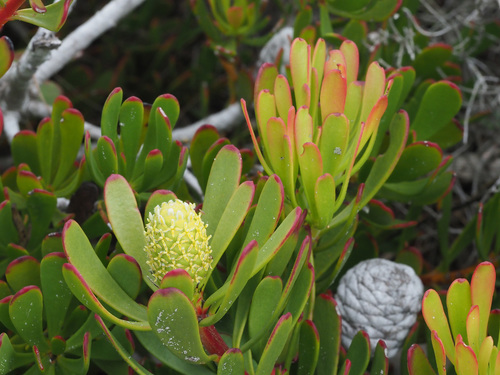
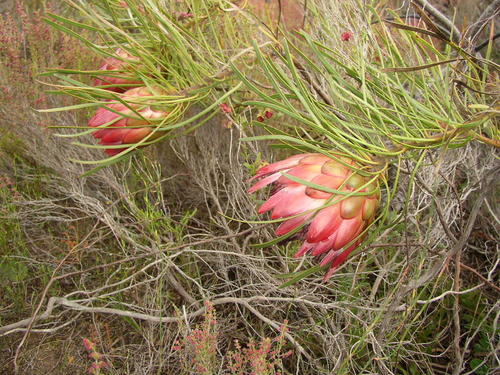
Protea pudens Rourke grows as a prostrate shrub that lies flat along the ground, forming a mat up to 1 metre in diameter and 30 centimetres in height. It is sparsely branching, with stems reaching 1 centimetre in diameter. Its inflorescences, where blooms form, usually grow at ground level. It blooms in winter, from May to September, with peak blooming occurring from July to August. This species is monoecious, with both male and female reproductive structures present in each individual flower. The flowers have no scent, and the bracts that subtend the inflorescence are deep pink. Protea pudens Rourke is endemic to the southwestern Cape Region of South Africa, restricted to a small area on flats near the village of Elim and other parts of the Agulhas Plain in the Western Cape province. Its total extent of occurrence is only 67 km², and it is currently only known to grow at four localities. This plant grows in heavy sandy clay, or gravelly soils derived from shale, at altitudes ranging from 23 metres to 40 metres. It grows specifically in ferricrete-soil fynbos habitat. Pollination of this species is carried out by birds. Wildfires destroy mature Protea pudens Rourke plants, and only the seeds survive these events. The seeds are stored in woody, persistent capsule fruits held in a dried, fire-resistant seed head that remains on the plant after the plant dies. After a wildfire, the seeds are released from the capsules and dispersed by wind.