About Protea neriifolia R.Br.
Size and Stem Features
Protea neriifolia R.Br. is a large, erect shrub or small tree that reaches 3 to 5 metres in height. Mature stems are glabrous, meaning hairless.
Leaf Characteristics
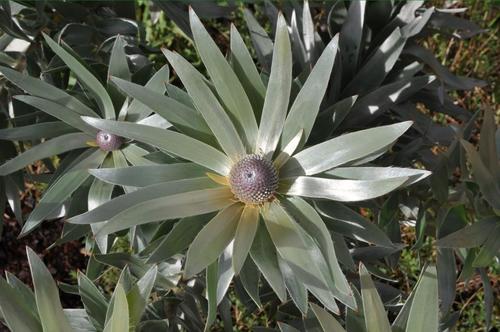
Its leaves are sessile, meaning they have no petiole and grow directly from stems, and they characteristically curve upwards. They are elliptic in shape, coloured green or blue-grey, with margins that run parallel to each other, and become glabrous when mature.
Flowering Period
This species blooms in summer and spring, though flowering has also been recorded in winter and autumn. It is monoecious, with both male and female reproductive structures present in each individual flower.
Inflorescence Structure
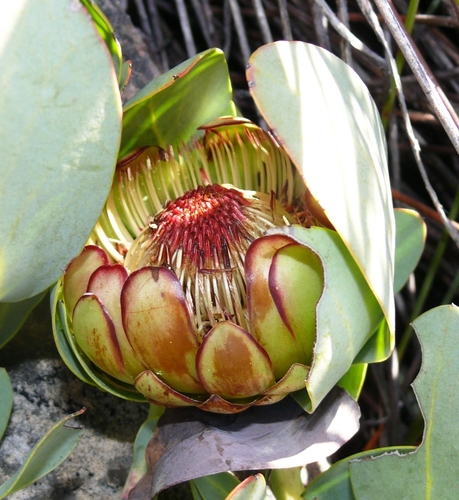
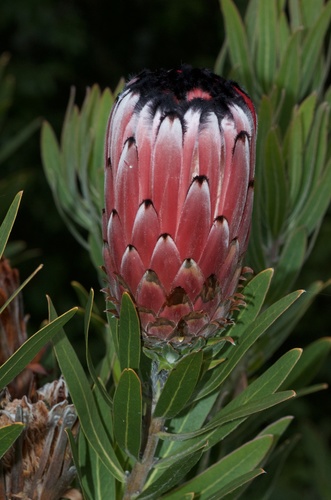
Flowers are arranged in a specialized inflorescence called a flower head, with only one inflorescence per branch. The inflorescence of this species is characteristically shaped like a long, oblong cone, and measures 13 by 8 cm.
Flower Head Traits
The flower heads are cup-shaped, and the individual flowers inside them produce nectar. The inflorescence is subtended by specialized structures called involucral bracts.
Outer Bract Features
Outer bracts range in colour from carmine to pink to creamy-green or whitish, and this colour contrasts with a characteristic hairy black fringe along the margins of the bract apex.
Inner Bract Features
Inner bracts are oblong to spatulate in shape, and typically curve inwards at their tips. These tips are rounded, and covered in a fuzzy black beard of hairs that is sometimes white.
Fruit and Seed Dispersal
The fruit is a nut with a surface densely covered in hairs. Small nuts are packed together within the dried inflorescence, which remains attached to the plant after the structure has senesced. When seeds are finally released, they are dispersed by wind.
Geographical Distribution
Protea neriifolia grows in the Western and Eastern Cape provinces of South Africa, specifically in the southern coastal mountain ranges between Cape Town and Port Elizabeth. Its confirmed growing locations include the mountain ranges of Hottentots Holland, Langeberg, Groot Winterhoek, Elandsberg, Rooiberg, Kammanassie, Potberg, Riviersonderend, Kogelberg and Jonkershoek, as well as Garcia's Pass and areas near the towns of Tulbagh and Ceres.
Habitat Vegetation
This species is found in fynbos vegetation growing alongside restios. It usually forms dense stands on south-facing slopes, and sometimes grows alongside Leucadendron xanthoconus.
Soil and Altitude Preferences
It grows in sandy soils derived from sandstone, and occasionally in sandy soils derived from granite, at altitudes between sea level and 1,300 metres.
Fire Response
Periodic wildfires destroy mature P. neriifolia plants in this habitat, but the species' seeds can survive these fires.
Pollinators
Flowers are pollinated by birds, which are attracted by the nectar and insects present, as well as by various insects including protea beetles and scarab beetles. At Kirstenbosch Botanic Gardens, Cape sugarbirds (Promerops cafer) have been recorded visiting the flowers of this species.