About Protea nana (P.J.Bergius) Thunb.
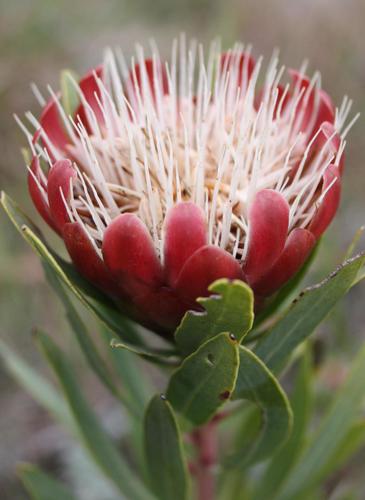
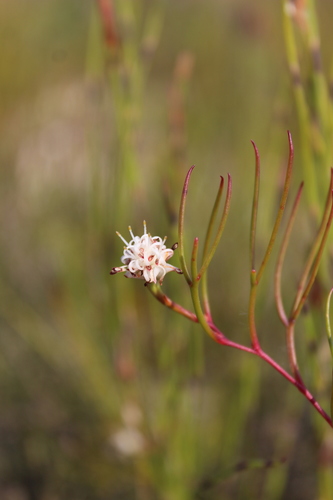
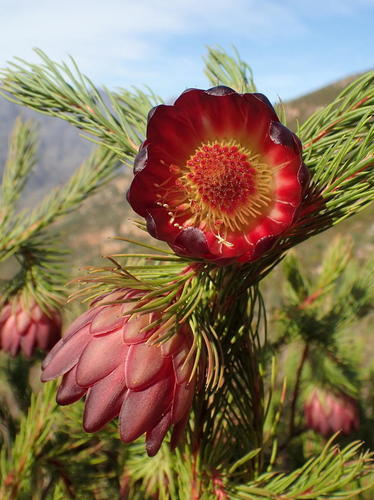
Protea nana grows as a small, rounded, highly branched shrub that reaches up to 1.3 meters in height. Cultivated individuals live approximately ten years. When carrying blooms, its branches curve gracefully outward. Young first-season branches are green, turning red the following season, and eventually becoming brown when mature. Its leaves are glabrous, deep green, soft, and needle-shaped; all needles curve upward, measuring 18–30 mm long and 1.0–1.5 mm wide. This species blooms from midwinter to early summer, with a main flowering period from July to October, and a broader potential range from June to November. It is monoecious, meaning each individual flower contains both male and female reproductive organs. The cup-shaped, pendulous downward-pointing inflorescences are subtended by oval bright red to crimson bracts, which enclose many much shorter, crimson-coloured flowers. Inflorescence colour can also range from burgundy, dirty faded red, to pale green. The nodding inflorescences sway in the wind, and the flowers produce a characteristic yeasty odour. Fruits take around seven months to ripen; these are woody, persistent fruits that remain on the plant after senescence. This species exhibits fire-mediated serotiny: seeds are retained inside the dry fruit for several years, and are only released after the parent plant is killed and burned by wildfire. Seeds are small, light, covered with a fine hair pappus, and dispersed by wind. Cooler night temperatures appear to stimulate seed germination. P. nana grows proteoid cluster roots that form a mat just a few centimetres thick, located just below the soil surface. This plant is endemic to the Western Cape province of South Africa, where it occurs from the Groot Winterhoek mountains, through the Du Toits Mountains, to the Skurweberg near Ceres. It can be found near the towns of Porterville, Ceres, Paarl, Tulbagh and Worcester, and usually grows in many isolated stands. It grows on mountain slopes at altitudes between 400 and 900 metres, preferring fynbos habitat. It grows on granite or sandstone-based substrates, growing on both dry sand and moist peaty loam, and prefers slightly acidic soil. The fynbos soils where it grows are typically very low in phosphorus. Wildfires kill mature P. nana plants, but their seeds survive these events. Its narrow, long leaves are an adaptation to conserve water, helping the plant survive fynbos’ hot, dry summers. As of 1998, the pollinators of this species were unknown. Compared to other proteas, P. nana produces very little nectar, though this nectar has a high sugar content that includes xylose. A combination of downward-facing flowers, distinct yeasty scent, high sugar content, and late winter flowering all suggested rodent pollination. Recorded flower visitors include sunbirds, and the rodent species Otomys irroratus, Micaelamys namaquensis, Rhabdomys pumilio and Myomyscus verreauxii. Pollen from this species was found on the noses or in the scat of all these rodents. M. verreauxi is the best climber of these species and is thought to be the main pollinator. In laboratory settings, Rhabdomys pumilio was sometimes heavily destructive to inflorescences; in the field, an average of 20% of inflorescences are destroyed over a two-month period, and this mouse is considered the likely culprit. The small mouse Micaelamys namaquensis can metabolize the xylose in the nectar via its intestinal gut flora. Otomys irroratus does not appear to pollinate the species. Even when rodents and birds were excluded with wire mesh cages that allowed insect access, plants still produced a significant amount of seed. No significant seed set occurred when insects were also excluded, which indicates that rodents are only partially responsible for pollination of this species. Protea nana holds up well as a cut flower.