About Protea montana E.Mey. ex Meisn.
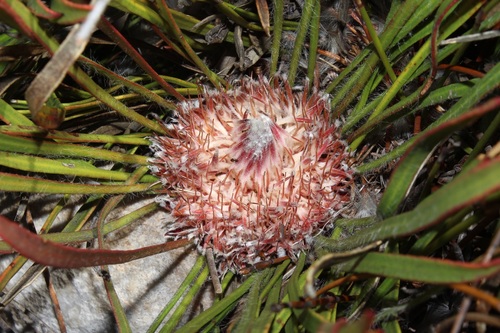
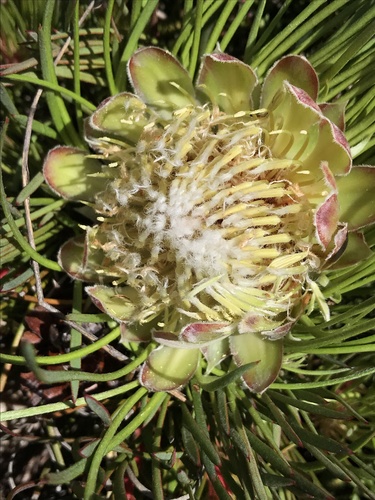
Protea montana, commonly called the Swartberg sugarbush, is a flowering plant in the genus Protea, family Proteaceae. It is endemic to the southwestern Cape Region of South Africa, and its Afrikaans common name is swartbergsuikerbos. This species is endemic to the Western Cape province of South Africa, where it occurs only in the Swartberg and Kammanassie Mountains. Its total extent of occurrence (the total area of the region where it may be found) is 1447 km², while its actual area of occupancy (the area it actually occupies) is only 112 km². It grows only near mountain summits, and its different population fragments are scattered across its range, with particularly heavy fragmentation in the Kammanassie Mountains. It occurs as solitary, scattered plants that grow sporadically across the landscape. Protea montana grows on mountain tops and their steep upper slopes, at altitudes between 1,600 and 2,000 metres. It inhabits montane fynbos on sandstone-derived substrates, favouring south-facing slopes. Periodic wildfires that sweep through its range kill mature plants, but the species' seeds are able to survive these fires. It produces blooms between February and June. Its florets are pollinated by rodents. Seeds are stored in old, dry, fire-resistant infructescences, and are released two years after fires pass through the area. The seeds are then dispersed by wind. In 1829, Drège first collected this species growing in rocky sites, alongside Restio laniger, Seriphium plumosum, Leucadendron dregei, and unidentified species of Sorocephalus, Erica, Hoplophyllum and Calopsis.