About Protea lorea R.Br.
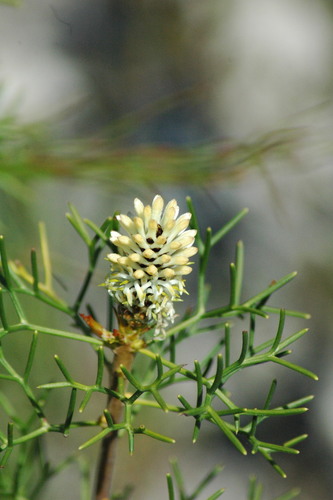
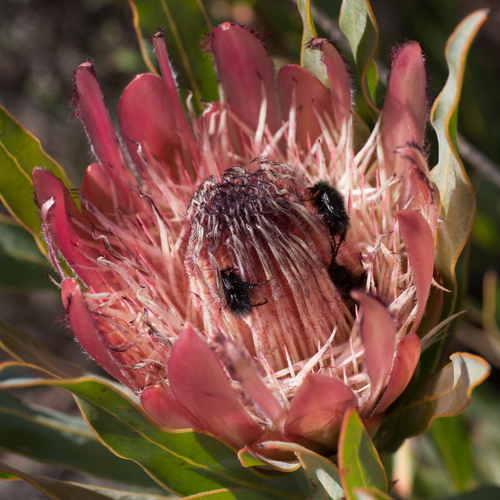
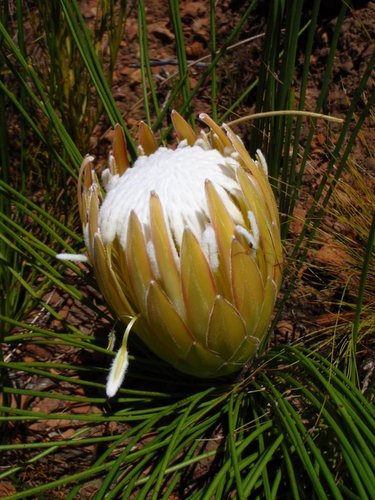
Protea lorea R.Br. is a low-growing shrub that forms a mat up to one metre in diameter. It blooms in summer, from January to February, when large yellow inflorescences emerge at ground level from small tufts of grass-like leaves. All individual flowers of this species are hermaphroditic, containing both male and female reproductive structures. Pollination is thought to be carried out by birds. The fruits produced by the species are woody and persistent, meaning they remain attached to the plant after the plant tissue senesces. Seeds are retained inside the dry fruit for an extended period, being released one to two years after flowers form, after which they are dispersed by wind. Because it shares its habitat with reed-like restio plants, it is easily mistaken for restios and has often been overlooked in local flora surveys. This species is endemic to South Africa, where it is restricted to the Western Cape. Its range extends from the Wemmershoek Mountains through the mountains of Kogelberg, Riviersonderend, Langeberg, and the Hottentots Holland Mountains in the Helderberg region, reaching as far as the towns of Ceres and Caledon. Within its range, plants grow as scattered individual plants in restricted localised areas. In terms of ecology, Protea lorea grows on grassy lower mountain slopes in soils derived from shale or sandstone, at altitudes between 450 and 650 metres. It grows in the fynbos habitat type, and can re-sprout from its underground rhizome after above-ground growth is burned away in wildfires.