About Protea foliosa Rourke
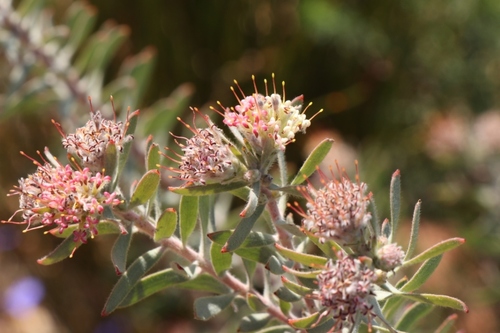
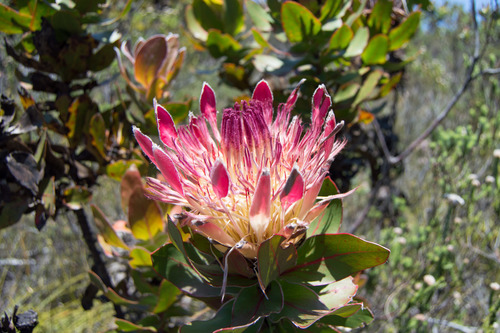
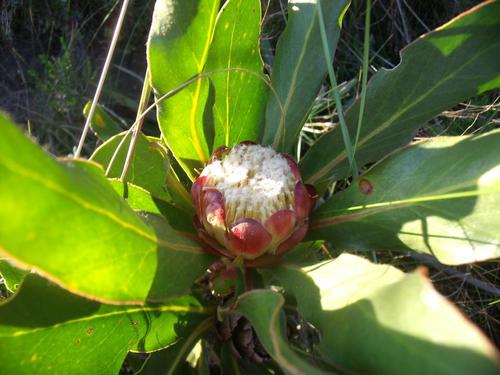
Protea foliosa Rourke, commonly called the leafy sugarbush, is a flowering plant in the genus Protea, family Proteaceae, and is endemic to the Cape Region of South Africa. In Afrikaans, it goes by the name ruie-suikerbos.
This species is endemic to the Eastern Cape province of South Africa. Its distribution ranges from Elandsberg to Port Elizabeth, and from Riebeek East to Makhanda (previously known as Grahamstown) or Bushman's River Poort. It occurs either as scattered individual plants or as locally abundant populations, and its total extent of occurrence is 9750 km².
P. foliosa grows almost exclusively in fynbos habitat, in the far eastern part of the fynbos range, but around Makhanda it grows in grassland thicket. It grows in soils derived from sandstone, quartzite, or sometimes sedimentary conglomerates. It is most often found at moist sites, where it can become locally abundant, at altitudes between 150 and 600 (or 610) metres.
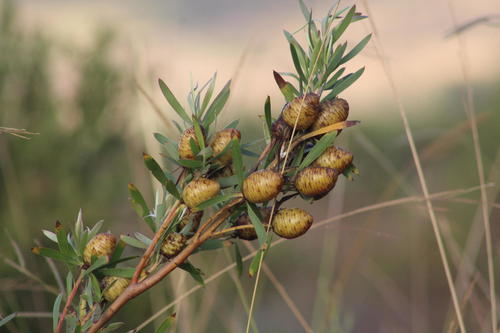
After periodic wildfires pass through its habitat, Protea foliosa is able to re-sprout from an underground bole. Its seeds are stored in old, dried, woody, fire-resistant seed-heads (infructescences) on the plant. Seeds are released two years after fires, and are dispersed by wind. While one source claims the florets are pollinated by birds and insects, a theory first proposed in 1977 argued that pollination is carried out by rodents. A 2015 research paper found evidence that the main diurnal pollinator of this species is Rhabdomys pumilio.