About Protea eximia (Knight) Fourc.
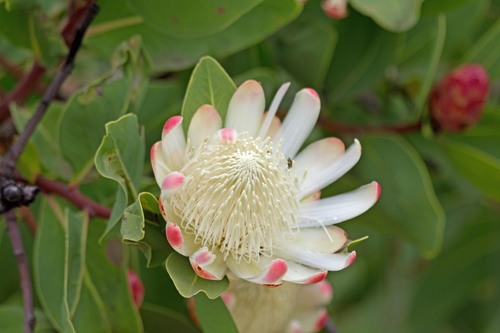
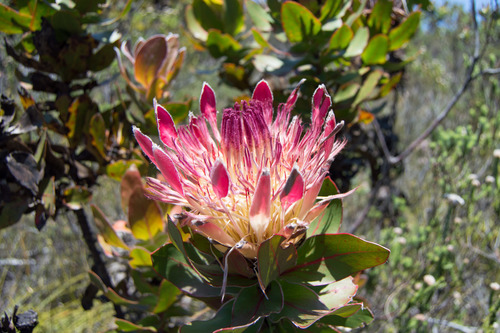
Protea eximia (Knight) Fourc. is an upright, somewhat sparsely branched shrub that grows into a small tree, reaching 2 to 5 meters in height and up to 300 millimeters in trunk diameter. Its flowering stems measure 7 to 10 millimeters in diameter; they are initially hairy and become smooth with age. Leaves are semi-flattened to fully flattened, 60 to 100 millimeters long, 30 to 65 millimeters broad, and oval to elongated oval in shape. They have a strongly heart-shaped base, an acute tip, are leathery, smooth, and glaucous. The flower heads are shaped like inverted cones, 100 to 140 millimeters long and 80 to 120 millimeters across when fully open. Their base forms a shallow, pointed cone 25 to 30 millimeters wide and 15 to 20 millimeters high. Involucral bracts are arranged in 5 to 6 series, clearly split into outer and inner groups, with a silky texture on the outer surface. Outer series bracts are oval to broadly elongated oval, 10 to 15 millimeters wide and 10 to 25 millimeters long, with tips ranging from rounded to acute, ciliate margins, and a greenish yellow to yellowish orange color with broad blackish margins. Inner series bracts are acuminate to spatulate, 8 to 15 millimeters wide and 40 to 100 millimeters long, colored yellowish near the base and fading to pale crimson at the tips. This protea species was discovered by James Niven around 1805 during an exploration journey in the Swartberg (Black Mountains), Cape Province, South Africa. Within five years of discovery, the species was in cultivation in the Cape, and was later exported to Europe for cultivation. Protea eximia is widely distributed along the coastal mountains of far southern Africa, ranging from Worcester in the west to Port Elizabeth in the east. It grows in a wide variety of habitats, at a range of altitudes, and tolerates many different temperature regimes. This adaptability has allowed it to be grown outdoors as far north as the coast of Cornwall in the United Kingdom. In the wild, this species forms dense, large communities that can stretch across several kilometers, and can be so dense that they are virtually impenetrable. Over time, natural thinning of these stands occurs, leaving fewer, larger individual specimens. It flowers mainly from August to October, but flowering can start as early as July and continue through December. Large dense stands of this species produce a striking display of large, colorful inflorescences. Protea eximia is one of the easiest protea species to cultivate, and can be grown across a very wide range of habitats. When grown from seed, it germinates within three weeks of planting and grows rapidly. It may begin flowering in its second year, but more typically starts flowering in the third year. It can reach a height of around 1.5 meters within eight years. It grows best when planted in small, closely spaced stands, where individual plants can support each other. Its leaves are susceptible to infestation by leaf miners.