About Protea cynaroides (L.) L.
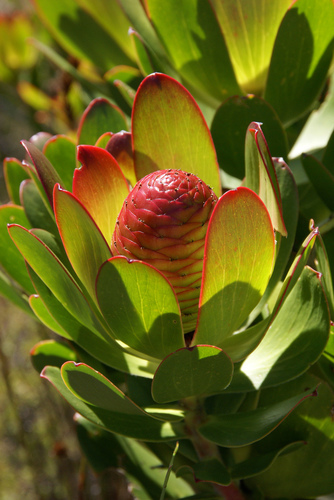
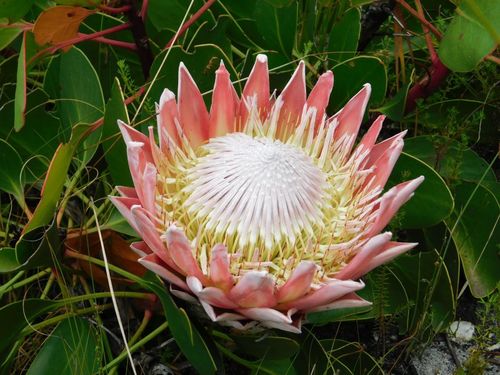
Protea cynaroides is a woody shrub with thick stems and large, glossy dark green leaves. Most mature individuals reach one meter in height, though height ranges from 0.35 to 2 meters (1 ft 2 in to 6 ft 7 in) depending on location and habitat. The so-called "flowers" of this species are actually composite flower heads called inflorescences. They hold a cluster of small flowers in their center, surrounded by large colorful bracts, and measure 120 to 300 millimeters (5 to 12 in) across. Large, vigorous plants produce six to ten flower heads in a single growing season, while some exceptional individuals can produce up to forty flower heads per plant. Bract color ranges from creamy white to deep crimson, but soft pale pink bracts with a silvery sheen are the most valued. This species, commonly called king protea, is widely distributed across the southwestern and southern regions of South Africa's Western Cape. Protea cynaroides grows in a harsh environment with dry, hot summers and wet, cold winters. It has several key adaptations to this habitat: tough, leathery leaves that reduce excessive moisture loss, and a large taproot that grows deep into soil to access underground moisture. Like most other Proteaceae, P. cynaroides produces proteoid roots: roots with dense clusters of short lateral rootlets that form a mat just below the soil's leaf litter. These roots improve nutrient solubilisation, allowing the species to take up nutrients in the low-nutrient, phosphorus-deficient soils of its native fynbos habitat. A range of nectar-feeding birds, primarily sunbirds and sugarbirds, feed at the species' inflorescences. Recorded visitors include the orange-breasted sunbird (Anthobaphes violacea), southern double-collared sunbird (Cinnyris chalybeus), malachite sunbird (Nectarinia famosa), and the Cape sugarbird (Promerops cafer). To reach nectar, a bird must push its bill into the inflorescence, which brushes pollen onto the bird's bill and face, enabling pollination. Along with birds, many insects are also attracted to the flower heads, including bees such as the Cape honeybee, and various beetle species including rove beetles, members of the large family Scarabaeidae like the protea beetle Trichostetha fascicularis, and monkey beetles. Like many other Protea species, P. cynaroides is adapted to an environment where regular bushfires are required for reproduction and regeneration. Most Protea species fall into one of two broad groups based on their response to fire: reseeders are killed by fire, but fire triggers the release of their canopy-held seed bank to support new generation recruitment; resprouters survive fire, regrowing from a lignotuber, or more rarely from epicormic buds protected by thick bark. P. cynaroides is a resprouter, growing new stems from buds in its thick underground stem after a fire. The king protea is the national flower of South Africa, and it gives its name to the country's national cricket team, nicknamed the Proteas. In the early 1990s, a political debate took place over whether and how to replace the springbok with this flower on the national rugby team's shirts. It also serves as the flagship species for the Protea Atlas Project, run by the South African National Botanical Institute. As a cut flower, king protea has a long vase life for arrangements, and it works very well as a dried flower. It occurs in multiple color forms, and horticulturists have recognized 81 distinct garden varieties. Some of these varieties have been planted improperly within the species' natural native range. In some cultivated varieties, the typical pink flower color and red leaf borders are replaced with creamy yellow.