About Protea angolensis Welw.
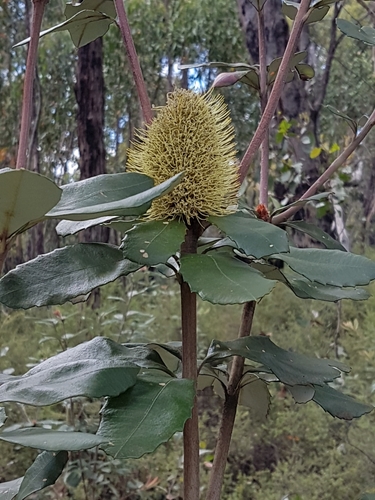
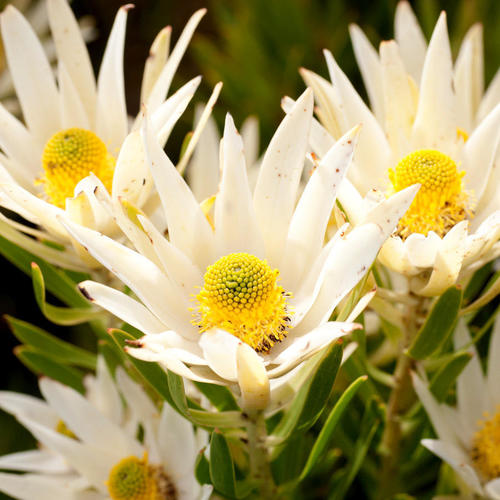
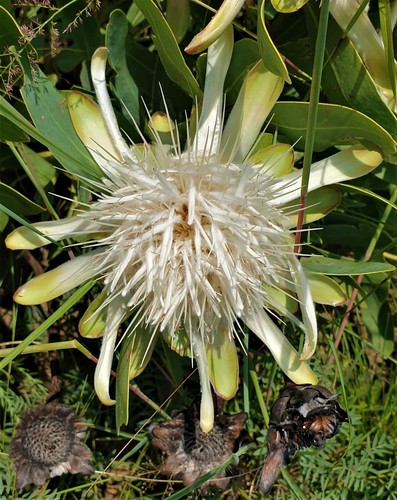
The leaves of Protea angolensis Welw. are leathery, hairless, green to bluish-green, and oval-shaped, reaching 16 cm × 8 cm (6.3 in × 3.1 in) in size. Its inflorescences, also called flowerheads, grow solitarily, and may reach approximately 10 cm × 12 cm (3.9 in × 4.7 in) in size, sometimes smaller, with a diameter between 8 and 12 cm (3.1–4.7 in). Its involucral bracts range in color from pale green to bright pink or red. The inner bracts can be either heavily or sparsely covered in silvery silky hairs, and this difference is usually caused by the age of the inflorescence, as the hairs fall off as the structure ages. The fruit is a densely hairy nut. GBIF recognizes three varieties of Protea angolensis. One of these, var. divaricata, is a small tree that grows up to 4 m (13 ft) tall, grows in miombo vegetation, and flowers later than the nominate form, blooming from April to July. The flowers and bracts of var. divaricata are bright pink, dark pink to red. This species occurs in northern, central and eastern Zimbabwe, across all of Zambia, western Angola, southern Democratic Republic of the Congo, Burundi, southern and western Tanzania, northern Malawi, and in a limited area of Mozambique, restricted only to Tete. In Zambia, it is found across the whole country, and has been recorded in North-Western Province, Northern Province (specifically the Bangweulu Wetlands), Lusaka Province, Southern Province and Western Province. Ecologically, this species is the host plant for the larvae of the butterflies Capys disjunctus and C. connexivus.