About Prostanthera spinosa F.Muell.
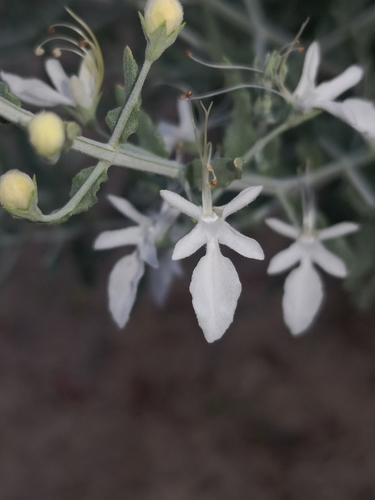
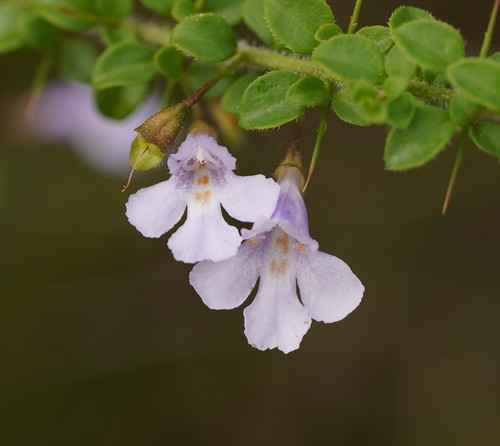
Prostanthera spinosa is a small, rigid, upright shrub with a scrambling, mostly semi-prostrate growth habit, typically growing between 0.2–2 m (7.9 in – 6 ft 6.7 in) tall. Its aromatic branches can be sparsely to moderately densely covered with hairs that spread upward, and are either straight or curled, and measure 0.2–1 mm (0.0079–0.0394 in) long. Alternately, branches can be mostly smooth, with only a few hairs at the nodes, and always bear opposite decussate spines that are 6–16 mm (0.24–0.63 in) long. The small leaves are either thickly hairy, or have only occasional hairs, mostly on the petiole. Leaves range in shape from narrowly egg-shaped to broadly elliptic or trullate, and are 1.5–6 mm (0.059–0.236 in) long, 1–3 mm (0.039–0.118 in) wide, with a petiole 0.4–1 mm (0.016–0.039 in) long. The upper leaf surface is darker than the paler underside. Leaves can be smooth, or have firm, spreading hairs along the midrib on the underside, and are profusely covered with glands. Leaf margins are entire or slightly rolled under, veins on the underside are obscure, and leaves end in a rounded apex, on a petiole 0.4–1 mm (0.016–0.039 in) long. Flowers grow singly in leaf axils, and range in color from pale mauve to lilac to white, with orange-brown streaks or spots on the lower inner petal, which is 2–3 mm (0.079–0.118 in) long. The bracteoles persist until the flower reaches maturity, and measure 0.9–2 mm (0.035–0.079 in) long and 0.2–0.3 mm (0.0079–0.0118 in) wide. Flowering occurs between July and December. This species, commonly called spiny mintbush, grows in rocky locations with shallow sandy soil in the Grampians. In South Australia, it grows near watercourses, mostly in loamy-sand overlying limestone or sandstone.