About Prostanthera serpyllifolia (R.Br.) Briq.
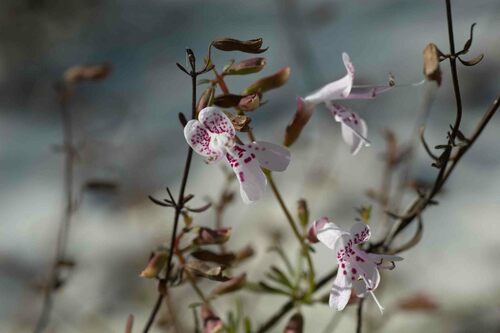
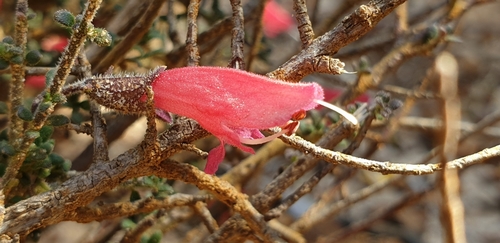
Prostanthera serpyllifolia (R.Br.) Briq. is a prostrate to erect shrub that typically grows to a height of less than 0.5 m (1 ft 8 in), and has hairy white branches. Its leaves are egg-shaped to broadly elliptic, measuring 1.5–3 mm (0.059–0.118 in) long and 0.7–1.3 mm (0.028–0.051 in) wide. The leaves are either sessile or borne on a petiole up to 1.5 mm (0.059 in) long. Flowers are arranged in leaf axils on a pedicel 1–5 mm (0.039–0.197 in) long, with bracteoles that are usually 2–4 mm (0.079–0.157 in) long at the base of the sepals. Sepals are 5–7.5 mm (0.20–0.30 in) long, forming a tube 3–5 mm (0.12–0.20 in) long with lobes 1.5–2.2 mm (0.059–0.087 in) long. Petals are 15–22 mm (0.59–0.87 in) long, forming a tube 9–14 mm (0.35–0.55 in) long; petal color ranges from bright pink to mid red, and petals are often white near the base, sometimes with a yellow tinge, and sometimes have a metallic bluish green tint. The lower middle lobe of the petal tube is 3–4 mm (0.12–0.16 in) long and wide, while the side lobes are 1–4.5 mm (0.039–0.177 in) long and wide. The upper lip of the petal tube is 5–7 mm (0.20–0.28 in) long and wide, with a small central notch. Flowering occurs in April, or from June to December. Prostanthera serpyllifolia is found in New South Wales, Victoria, South Australia and Western Australia, where it most often grows in mallee communities, usually on limestone or calcrete. Subspecies microphylla occurs in New South Wales west of near West Wyalong, in the far north-west of Victoria, in the south east of South Australia, and along the southern part of Western Australia as far west as the southern Avon Wheatbelt. Subspecies serpyllifolia occurs on the Yorke and Eyre Peninsulas in South Australia, with one single recorded occurrence in the southwest of Western Australia.