About Prosotas nora (Felder, 1860)
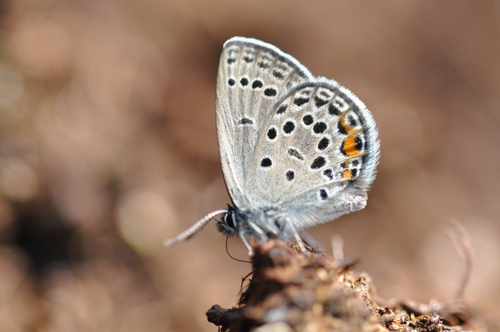
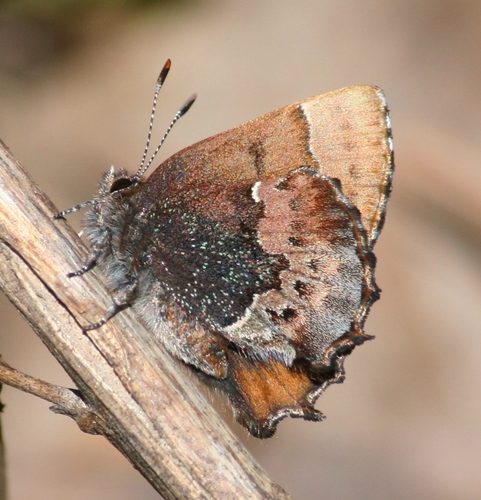
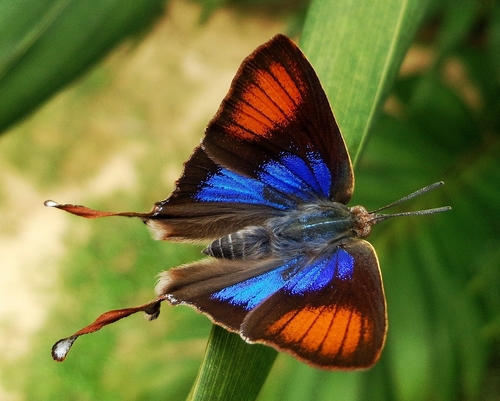
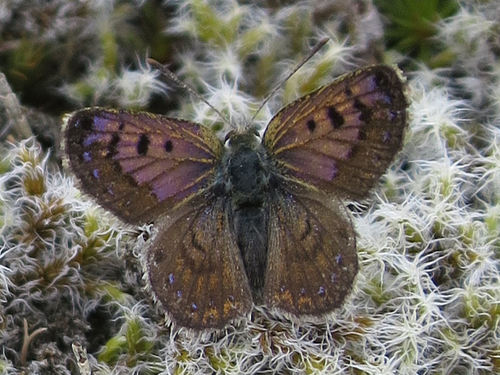
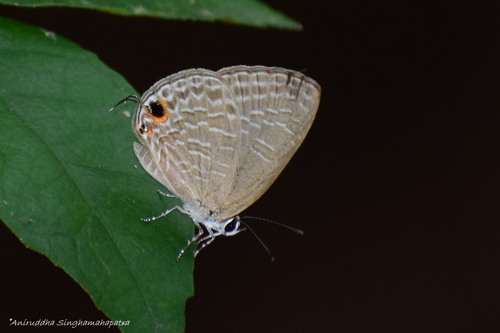
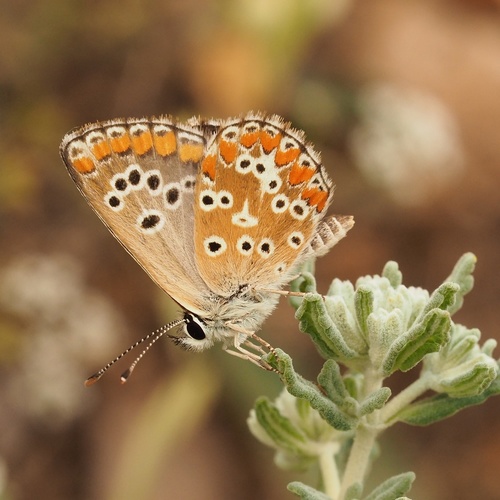
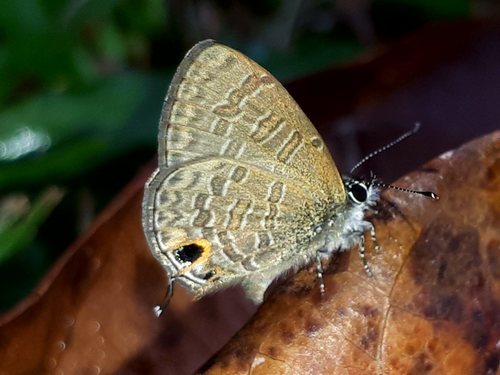
Prosotas nora (Felder, 1860) exhibits clear sexual dimorphism in wing patterning. For males, the upperside wing color ranges from purplish brown or purplish with a dark tint; some specimens are brown with a very faint purplish sheen that is only visible under certain lighting. Both forewings and hindwings are nearly uniformly colored, and both have thin black anteciliary lines. On the hindwing, the costal and dorsal margins are paler than the rest of the wing. Most males have a subterminal black spot in interspace 2, which is sometimes only visible by transparency through the wing from the underside. The tail is black with a white tip. The underside is brown, hoary brown, brownish, or pale dull brown. On the forewing, there is a subbasal pair of transverse white strigae, a shorter pair along the discocellulars, and a discal pair. Each pair of these strigae is narrowly edged with fuscous on their inner sides, creating the appearance of transverse bands that are slightly darker than the surrounding ground color. The subbasal pair extends from vein 1 to vein 12, the discocellular pair extends from the upper to the lower apex of the cell, and the discal pair is very irregular and dislocated at every vein, giving the entire marking the shape of a dark sinuous band. Terminal markings are often very faint and ill-defined, but can also be fairly prominent: they consist of a double subterminal series of transversely linear, sometimes lunular, dark spots with edges paler than the ground color, and end with an anteciliary dark line. On the hindwing, there are transverse pairs of white strigae with inner fuscous edges, matching those on the forewing but even more irregular and broken. The subbasal pair extends from the costa to vein 1; the dorsal area below vein 1 is whitish. The discocellular pair extends from the costa and coalesces posteriorly with the discal pair, which is just as irregular and dislocated as the discal pair on the forewing. Terminal markings match those on the forewing, but the double subterminal series of dark spots is more distinctly lunular, and there is a prominent round black subterminal spot capped with ochraceous in interspace 2. The antennae, head, thorax, and abdomen are dark brown; the shafts of the antennae are speckled with white. On the underside, the palpi are fringed with black, the thorax is dark greyish brown, and the abdomen is white. For females, the upperside is brownish purple, sometimes fuscous. Like males, both forewings and hindwings have dark anteciliary lines, but females differ in several key traits. The forewing has an iridescent bluish sheen that extends from the base outward to the disc. On the hindwing, a thin, more or less prominent white line runs along the inner edge of the anteciliary black line. There is a geminate (paired) double black subterminal spot in interspace 1, and a similar, larger single black subterminal spot in interspace 2. The underside ground color is paler and brighter than in males, and the markings are similar but generally more neatly and clearly defined. In most female specimens, both forewings and hindwings have a white terminal line just before the anteciliary dark line. The antennae, head, thorax, and abdomen match the appearance seen in males. This species is distributed across Peninsular India from the outer Himalayas to Travancore, excluding desert areas; it is also found in Sri Lanka, Assam, Myanmar, Cambodia, Tenasserim, the Andaman Islands, and the Nicobar Islands, with its range extending into the Malayan subregion and the Philippines.