About Prosopis pubescens Benth.
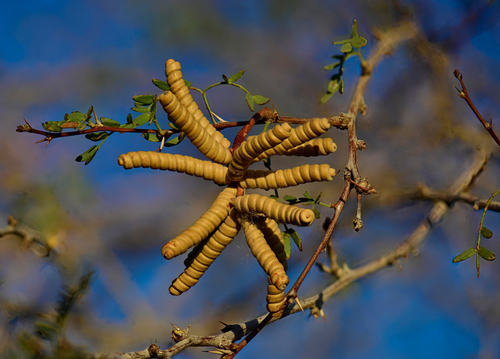
Prosopis pubescens Benth., commonly called screwbean mesquite, grows to around 7 meters (23 feet) tall. It has light brown bark, usually short straight spines that measure 1 to 3 centimeters long, twice-compound leaves, and many small yellowish flowers arranged in elongate spikes. Its tightly twisted seedpod legumes grow up to 5 centimeters long and strongly resemble turned screws. This shape may have evolved as a defense against seed predators such as bean weevils of the subfamily Bruchinae. Seeds germinate after they are scarified while passing through the digestive tracts of animals that eat the seedpods. The plant also grows in a clockwise spiral. This species is found along streams and valleys in deserts, particularly in damp or saline soil, and it grows alongside other characteristic plants of this habitat, including arrowweed (Pluchea sericea) and tamarisks. It can also grow on playas and other areas with alkaline substrates. Along with other mesquite species, Prosopis pubescens is a dominant plant in Mesquite Bosque-mesquite woodlands, a common habitat type in the desert southwest region. Many types of animals readily eat its seedpods, including several species of birds, rodents, and coyotes. Many bird species nest and roost in these trees, and small mammals find shelter in thicketlike stands of the plant. Like the seedpods of other species in the Strombocarpa, Neltuma, and Prosopis genera, the nutritious seedpods of screwbean mesquite are edible. The Pima people cooked the pods in dirt-covered pits over periods of a few days. Mesquite is a traditional Native American food source, used to make meal, cakes, and syrup. It has been used as a staple food for centuries by desert dwellers. The high protein meal made from this plant contains good amounts of calcium, magnesium, potassium, iron, and zinc, and is also rich in the amino acid lysine. Mesquite meal is high in fiber, moderate in sugar, and 8% protein by composition. It has a sweet, rich, molasses-like flavor with a hint of caramel that blends well into smoothies or other drinks, especially those made with cacao and maca. The fruits can also be used as a coffee substitute.