About Prosopis juliflora (Sw.) DC.
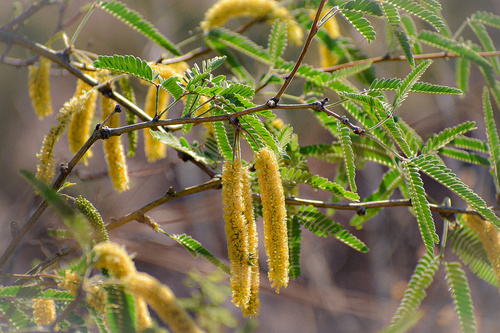
Prosopis juliflora (Sw.) DC. (referred to as N. juliflora in this source) grows up to 12 metres (39 feet) in height, with a trunk diameter reaching up to 1.2 m (4 ft). Its leaves are deciduous, geminate-pinnate, light green, and bear 12 to 20 leaflets. Flowers develop shortly after new leaves emerge; they form green-yellow cylindrical spikes 5–10 centimetres (2–4 inches) long, arranged in clusters of 2 to 5 at the ends of branches. Pods are 20 to 30 cm (8 to 12 in) long, holding 10 to 30 seeds per pod. A mature individual can produce hundreds of thousands of seeds, which remain viable for up to 10 years. This tree reproduces only from seeds, not vegetatively. Seeds are dispersed by cattle and other animals that eat the seed pods and spread seeds through their droppings. Like other Prosopis species, its roots can grow to great depths to search for water. This tree is recorded to have been introduced to Sri Lanka in the 19th century, where it is called vanni-andara or katu andara in Sinhala. There is a claim that it existed and was recognized as a holy tree in ancient India, but this is most likely a confusion with the superficially similar Prosopis cineraria. It is believed to have been present in Sri Lanka's Vanni and Mannar regions for a long time. The species has paired thorns at its nodes. Thorniness varies between individuals, and nearly thornless plants occasionally occur. In the western part of its range in Ecuador and Peru, this species readily hybridizes with Neltuma pallida, and it can be hard to distinguish from that similar species or their interspecific hybrid strains. Despite having a relatively short maximum lifespan of 60 years, it is a very hardy plant. Its seed pods contain neurotoxic alkaloids, which are toxic to livestock when eaten in excess. The sweet pods are edible and nutritious, and have served as a traditional food source for indigenous peoples in Peru, Chile and California. Historically, pods were chewed during long journeys to reduce thirst. They can be prepared in many ways: eaten raw, boiled, dried and ground into flour for bread, stored underground, or fermented to make a mildly alcoholic beverage. Additional uses for this species include forage for livestock, timber, and environmental management. Its heartwood contains an unusually high amount of the flavanol (-)-mesquitol. In Macará Canton, Ecuador, it grows in dry forests and is one of the most commonly harvested species for multiple forest products. It is also a rich source of honey.