About Prosartes trachycarpa S.Watson
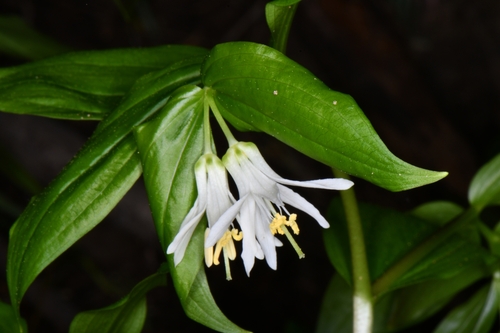
Prosartes trachycarpa S.Watson, commonly called rough-fruited fairybell, is a herbaceous perennial. It reaches a height between 30 centimeters (12 inches) and 80 centimeters (31 inches). Its stems are only sparingly branched; young stems have a softly fuzzy texture, and become smooth or nearly smooth as they age. Leaves are alternate, growing between 4 centimeters (1.6 inches) and 12 centimeters (4.7 inches) long. Delicate flowers hang down from stem tips, and each flower has four petals. The berry of this plant is larger than the berries of Saskatoon, pincherry, or chokecherry, and is about the size of a commercially sold grocery store cherry or a small grape. This species can grow in the same locations as other native fruits including Saskatoons and chokecherries. Unripe berries start out yellow, then turn orange as they develop, and become red when fully ripe; it is common to see all three colors present on the same raceme. Typically, 2 to 3 berries grow on each stem tip. The fruit surface has a fuzzy, velvety texture. The berries are edible, but have a bland flavor. This species is recorded as one of the plants found in Prince Albert National Park and Riding Mountain National Park, and it is considered a common range plant of northern Saskatchewan. Historically, Blackfeet Native Americans have eaten its berries.