About Propylaea quatuordecimpunctata (Linnaeus, 1758)
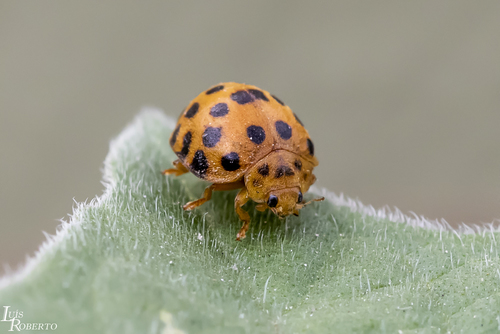
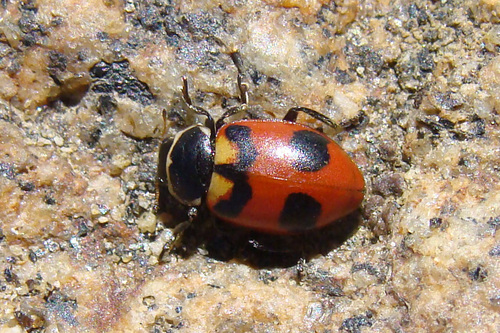
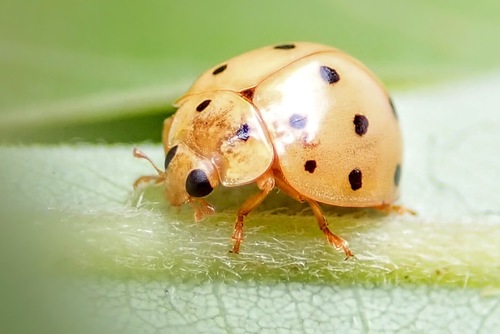
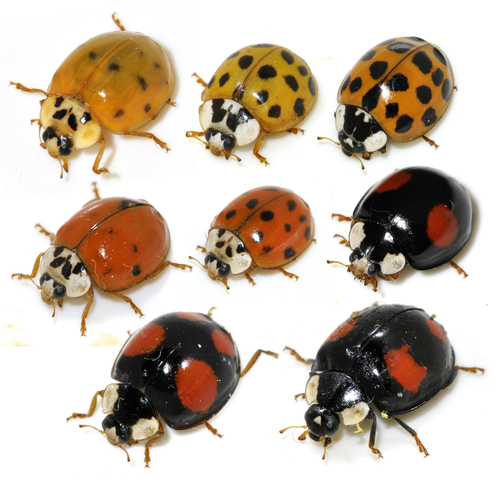
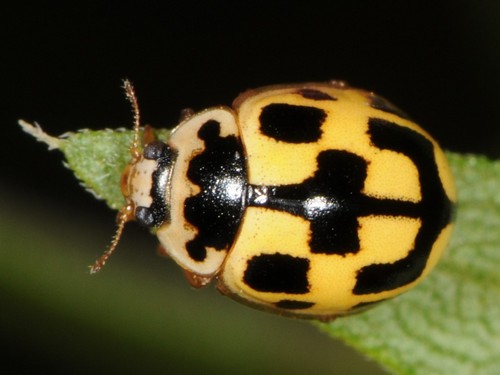
Propylaea quatuordecimpunctata, first described by Linnaeus in 1758, are beetles measuring 3.5 to 4.5 millimeters in length. They have an extremely wide range of color forms, with more than 100 distinct color and pattern variations. Some of these variations differ so greatly that the forms were originally classified as separate species. The background color of this beetle ranges from cream to yellow to light orange, and is never red. Typically, 14 almost rectangular black spots appear on the elytra, but it is rare for all these spots to remain fully separate from one another. Most often, several spots fuse together to form larger markings. This fusion is particularly common along the midline, where it often produces an anchor-like shape. In some cases, fusion is extensive enough that almost all yellow coloration disappears, leaving the body almost entirely black except for 12 pale yellow spots. The pronotum is whitish or pale yellow, marked with four to eight black spots. The antennae and legs are yellowish-brown. This species is native and widely distributed across the Palearctic region, ranging north to the Arctic Circle. It is common in Europe, North Africa, Cyprus, European Russia, the Caucasus, Siberia, the Russian Far East, Belarus, Ukraine, Moldova, Transcaucasia, Kazakhstan, Western Asia, Pakistan, Mongolia, temperate China’s Tarim Basin deciduous forests and steppe, Korea, and Japan. The species is an introduced, now widespread, organism in North America, where it ranges from southeastern Canada through the Great Lakes region to Florida, and it is still spreading across the continent. Initial introductions to the United States were intentional, carried out to use the beetle as a control agent for the Russian wheat aphid, as noted by Hoebeke in 2019. These beetles occupy a very wide variety of habitats, ranging from lowlands to subalpine areas of the Prealps. They can be found in Western European broadleaf forests, mixed forests, meadows, fields, and other life zones of central Europe. They are also present in gardens and parks. They occur on grasses, herbaceous plants, bushes, and trees. Additionally, the species can be found in forest litter, on brushwood and coarse woody debris, in moss, in straw stored in sheds, in detritus and alluvial soil, in rotten plant residues, and in compost.